Debatable lands, p.1
Debatable Lands:, page 1
part #16 of Carlisle & Holbrooke Series
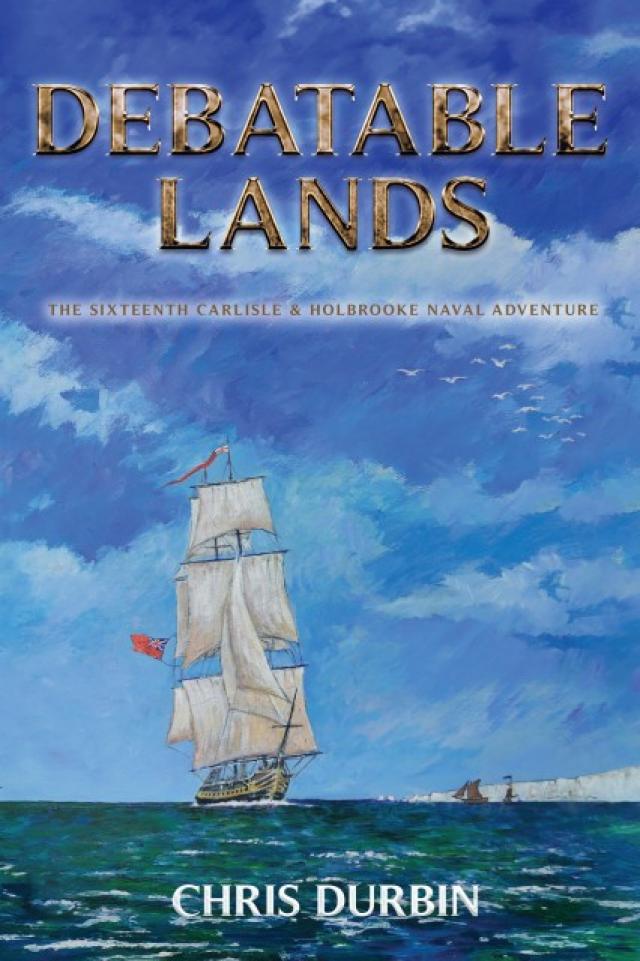


Debatable Lands
The Sixteenth Carlisle & Holbrooke Naval Adventure
Chris Durbin
Chris Durbin Author Ltd.
To our grandson George
Never stop smiling!
Methought I saw a thousand fearful wrecks;
Ten thousand men that fishes gnawed upon;
Wedges of gold, great anchors, heaps of pearl,
Inestimable stones, unvalued jewels,
All scattered in the bottom of the sea.
William Shakespeare
The Duke of Clarence’s dream
Richard III, Act I Scene IV
Contents
Title Page
Dedication
Epigraph
Nautical Terms
Principal Characters
Charts
Introduction
Prologue
Chapter One
Chapter Two
Chapter Three
Chapter Four
Chapter Five
Chapter Six
Chapter Seven
Chapter Eight
Chapter Nine
Chapter Ten
Chapter Eleven
Chapter Twelve
Chapter Thirteen
Chapter Fourteen
Chapter Fifteen
Chapter Sixteen
Chapter Seventeen
Chapter Eighteen
Chapter Nineteen
Chapter Twenty
Chapter Twenty-One
Chapter Twenty-Two
Chapter Twenty-Three
Chapter Twenty-Four
Chapter Twenty-Five
Chapter Twenty-Six
Chapter Twenty-Seven
Chapter Twenty-Eight
Chapter Twenty-Nine
Chapter Thirty
Epilogue
Fact Meets Fiction
Nautical Terms
Throughout the centuries, sailors have created their own language to describe the highly technical equipment and processes that they use to live and work at sea. This still holds true in the twenty-first century.
While counting the number of nautical terms that I’ve used in this series of novels, it became evident that a printed book wasn’t the best place for them. I’ve therefore created a glossary of nautical terms on my website:
Glossary
My nautical glossary is limited to those terms that I’ve mentioned in this series of novels as they were used in the middle of the eighteenth century. It’s intended as a work of reference to accompany the Carlisle & Holbrooke series of naval adventure novels.
Some of the usages of these terms have changed over the years, so this glossary should be used with caution when referring to periods before 1740 or after 1780.
The glossary isn’t exhaustive; Falconer’s Universal Dictionary of the Marine, first published in 1769, contains a more comprehensive list. I haven’t counted the number of terms that Falconer has defined, but he fills 328 pages with English language terms, followed by an additional eighty-three pages of French translations. It’s a monumental work.
There is an online version of the 1769 edition of The Universal Dictionary that includes all the excellent diagrams that are in the print version. You can view it at this website:
The Universal Dictionary
Principal Characters
Fictional
Captain George Holbrooke: Commanding officer, Argonaut
Lieutenant Carter Shorrock: First lieutenant, Argonaut
Lieutenant John Bearsley: Second lieutenant, Argonaut
Josiah Fairview: Sailing master, Argonaut
David Chalmers: Chaplain, Argonaut
Jackson: Bosun, Argonaut
Tom Carver: Master of a British trading brig
Captain Don Ezequiel Mancebo: Commanding Officer, San Sebastian
Lieutenant Fernando Guterres: First Lieutenant, San Sebastian
Miguel Crespi: Gunner’s Mate, San Sebastian
Ann Holbrooke: Captain Holbrooke’s Wife
Historical
The Honourable Edward Hay: Envoy Extraordinary to Portugal
William Barwell: Director of the Honourable East India Company
John McNamara: Master, Lord Clive
William Roberts: Master, Ambuscade
Pedro Antonio de Cevallos Cortés y Calderón: Governor of Buenos Aires
Colonel Vasco Fernandes Pinto Alpoim: Commander of the Portuguese expedition to the River Plate
Charts
Argonaut's Route to the River Plate
River Plate
Approaches to Buenos Aires
Approaches to Colonia do Sacramento
Colonia do Sacramento
Introduction
The Seven Years War in 1762
The war should never have lasted so long, and by September 1762 Spain had realised its monumental mistake in joining the conflict on France’s side. News of Havana’s fall was just starting to arrive in Madrid and although they wouldn’t know it for some months, a British expedition had already set sail from India to Manilla, which in October would likewise fall. Thus two of Spain’s most important colonial possessions would be lost in just a few months. To make matters worse, Spain’s first attempt at invading Britain’s ally, Portugal, had been beaten back along the Douro valley by a peasant army. The second attempt was already bogged down in the central mountains as British regiments arrived in Lisbon to bolster the Portuguese army.
France had staked everything on Spain’s entry into the war under the terms of the third Bourbon Family Pact, and had embarked upon another hugely expensive push to take territory in the German states. However, Spain was preoccupied with defending her own colonial possessions and the planned invasion of Portugal, while in Germany, Prince Ferdinand of Brunswick was still holding ground and frustrating King Louis’ attempts to invade Hanover.
All the principal warring parties – France, Spain, Austria, Prussia and Russia, even Britain – were exhausted, and it was clear to the Bourbon cousins, King Louis and King Carlos, that things could only get worse. Meanwhile the British navy ranged unchallenged across the oceans of the world, stifling her enemies’ trade and supporting her own.
Portugal, under the weak reign of King José, but the firm political leadership of the Marquis of Pombal, could see the way things were going and decided to claim by force the territory between the acknowledged southern border of Brazil and the Rio de la Plata, known as the Banda Oriental or the Debatable Lands. Pombal scraped together a small army, but for shipping and escorts he had to turn to Britain, to a makeshift consortium of merchant adventurers led by the Honourable East India Company.
Meanwhile, sporadic negotiations for peace were interrupted by the participants’ attempts to gain an advantage over their fellows, and the continual news of fresh setbacks for France and Spain.
It’s at this interesting point in history that our story – the sixteenth Carlisle & Holbrooke Naval Adventure – begins.
Carlisle and Holbrooke
Edward Carlisle spent the summer and autumn of 1762 in his ship Dartmouth as a part of the vast fleet and landing force that Vice-Admiral Pocock and Lord Albemarle took to the Caribbean to capture Havana. He was engaged in the superb feat of navigation that allowed the fleet to come at Havana by the back door, through the Old Bahama Straits, and he took part in the heroic but futile bombardment from the sea of the El Moro castle. The personal contacts that he had made in Havana when he visited the city before Spain entered the war made him indispensable in the negotiations for the eventual surrender of the city.
It wasn’t until November 1762 that a disillusioned and war-weary Carlisle brought his leaky ship back to New York, escorting a convoy of transports packed with the remnants of the American regiments that had besieged Havana. Having discharged the convoy, he set off from Sandy Hook for England into the teeth of an autumnal gale that beat his ship back and back until it could no longer claw its way off the eastern coast of the American colonies. With no options left he ran for shelter in Chesapeake Bay where Dartmouth was wrecked just inside Cape Henry. Carlisle didn’t remember being taken to his home in Williamsburg, but that is where we left him at the end of the fifteenth book, Old Bahama Straits.
George Holbrooke’s ship was the only one on station when, in May 1762, a French squadron commanded by an old and wily adversary broke out of Brest and into the Atlantic. He followed them all the way to Newfoundland where they attacked and captured Saint Johns, destroying Britain’s valuable cod fishery. Holbrooke joined the British force that ousted the French from Newfoundland and then followed them alone back across the Atlantic to a final confrontation off Brest in September. There he caught and destroyed the smallest of de Ternay’s ships, then lost sight of the remainder as they sped south to find a friendly port that wasn’t so closely blockaded.
The Inshore Squadron of the Channel Fleet arrived too late to prevent de Ternay’s escape, but the rear admiral in command was delighted to find this frigate that had appeared from nowhere to solve his problem. For his superior, Admiral Hawke, had ordered him to send a ship to Lisbon on a particular service.
This book, Debatable Lands, commences in September 1762 as a reluctant Holbrooke hears the bad news of his next mission.
Prologue
Merchant Adventurers
Monday, Twenty-Eighth of June 1762.
East India House, Leadenhall Street, London.
John McNamara stepped down from the carriage, adjusted his good blue broadcloth coat and without looking up –
◆◆◆
‘Captain McNamara, take a seat if you please.’
McNamara looked swiftly from side to side expecting to see at least two other directors of the company. That was the rule when dealing with sea captains, three directors at all times to maintain the advantage of numbers, but today he saw only William Barwell, who he remembered from his unpleasant interview three years ago. Like most of the directors, Barwell had gathered his wealth in India where he’d served as the President of Bengal for a year and a half. That was all the time that was needed to make his fortune and then he’d taken the first opportunity – hastened by a scandal left over from his previous post in Patna – to return to England to enjoy the fruits of his labours. A clerk sat to one side, quill at the ready, but otherwise they were alone.
Barwell looked steadily at his visitor, as though weighing his value. He seemed satisfied and rang a bell for coffee.
‘Has Captain Roberts reported his ship’s state to you?’
McNamara bit his tongue. No company captain should be spoken to like this, not even by a director. Yet he must endure it if he had any hopes of reinstatement.
‘Yes, he has. He expects to complete Ambuscade’s stores on Wednesday, at the same time as Lord Clive will be ready. We can drop down to take on our gunner’s stores and powder on the first of the month, and we can clear the London River on the third, weather permitting.’
‘Good, then it’s time that you understood where you are bound and upon what service.’
There was a pause while coffee was served. McNamara could have done with something a little stronger, but even coffee in a Chinese porcelain cup decorated with the company coat of arms and motto was a sign of… a sign of something.
‘You’ll be aware that this is not a company trading venture, but a joint endeavour with a number of shareholders, the East India Company being but one of them. That must be clear from the outset. I have been elected to be your point of contact with the shareholders and it is merely for my convenience that that I’ve invited you to receive your orders at East India House. I have here your letter of marque, pray take a moment to read it.’
McNamara skimmed the letter. It was in the usual form and the only obvious oddity was that it was signed by one of the Lord Commissioners of the Admiralty. Then whatever this venture was, it had the King’s approval and the navy’s blessing. There was no mention of the East India Company, just a vague reference to a joint stock company with no name. Yet his own name was there in black and white, just like the letters that had shielded him from accusations of piracy for the past two years as a privateer in the Caribbean. It told him nothing at all about his mission, which he was sure was no normal cruise against the enemy’s trade.
‘You’ll also be aware that Spain has taken the opportunity of war with Britain to invade Portugal. The Portuguese government is not content to merely defend its home territory but is determined upon improving its own position in South America. They are, of course, short of ships and seamen and money, and have asked for assistance. The company that I represent has been founded, at least initially, for a single purpose; that is to convey a Portuguese army – a modest but sufficient force, I’m told – to the River Plate, and there to annoy the Spanish.’
Barwell’s speech ended abruptly, and he sat in silence, apparently with little interest in the ship captain opposite him. The sounds of the street outside were muffled but both men could hear the high-pitched voice of a boy selling broadsheets.
‘Spanish army beaten in Portugal, British army embarks for Lisbon, read all about it, read all about it.’
The lad’s glottal stops and stretched vowels were distorted in their passage through the closed windows, and to anyone not used to a common Londoner’s speech he would have been unintelligible. Nevertheless, to those in the office his meaning was clear: Spain’s hurried attempt to seize the Douro River and the great wine exporting city of Oporto had failed. They hadn’t considered the problem of feeding their soldiers nor had they secured their supply lines. Now they were paying a terrible price as their attack was blunted by the crumbling Portuguese fortresses and their marching columns were mercilessly harried by a peasant army of irregulars. With no news yet from the great expedition to the West Indies, and with the armies in Germany reduced to a watchful stalemate, the broadsheets had become obsessed with this Spanish invasion of Britain’s ally. McNamara had heard little else after he stepped off the wherry at the Custom House stairs and made his way up Water Lane. After all, the wine trade with Oporto was one of the pillars of the stock market. There had been huge losses when word of the Spanish invasion had first reached the city, but doubtless the market would recover on today’s news. If it was certain that the Spanish would try again, then it was equally certain that the British army that was now on its way to Lisbon would at least protect the Portuguese capital.
‘Well, it appears that the whole of the City knows as much as I do.’
McNamara nodded in agreement and privately resolved to buy a broadsheet on his way back to Blackwall.
‘Then this army will join me at Lisbon, I understand.’
‘At Lisbon, yes. You can expect some five hundred men in two transports and some store ships. I expect whoever is in command will want to embark in Lord Clive with his staff. If that request is made you should agree but make it quite clear that they must victual themselves or pay for their meals like normal passengers. I expect you will be bound for Rio de Janeiro and there you should find a Portuguese man-of-war and additional men for the army. Much will be left to your judgement, Captain, but I would anticipate you placing your two ships at the disposal of the Portuguese commander, so long as he appears to be acting prudently.’
McNamara had never heard of such a strange enterprise and he struggled to keep the emotion from showing on his face. In his every previous dealing with the John Company the first thing that was hammered home was the need to make a profit, and the last parting shot repeated the point. Barwell had outlined this expedition as though it was a naval and military operation with conquest as its main objective but how would that benefit this mysterious joint stock company? He couldn’t leave it at that, he must ask the question.
‘I assume, sir, that the company’s interest in this expedition is in taking prizes, ransoming towns and a share of whatever plunder is taken.’
Barwell stared steadily at McNamara.
‘Of course, all of those items, Captain, and your share is outlined in the articles that I will require you to sign before you leave here. However, the company that I represent, and the Honourable East India Company, as two separate entities, expect a greater, longer-term benefit in trading rights in the River Plate area. The Portuguese hope to capture Buenos Aires and Montevideo, as well as holding onto Colonia do Sacramento; with those three places in their pocket they’ll dominate the whole of the River Plate and have a strangle-hold on trade in a vast stretch of the Spanish Vice Royalty of Peru. These are momentous days for the Company, if the River Plate can be seized by our allies with our assistance.’