Groundwork, p.54
Groundwork, page 54


* * *
Joubert: The end of life is bitter. Less than a year after writing those words, at the age of sixty-one, which must have seemed considerably older in 1815 than it does today, he jotted down a different and far more challenging formulation about the end of life: One must die lovable (if one can). You are moved by this sentence, especially by the words in parentheses, which demonstrate a rare sensitivity of spirit, you feel, a hard-won understanding of how difficult it is to be lovable, especially for someone who is old, who is sinking into decrepitude and must be cared for by others. If one can. There is probably no greater human achievement than to be lovable at the end, whether that end is bitter or not. Fouling the deathbed with piss and shit and drool. We are all going there, you tell yourself, and the question is to what degree a person can remain human while hanging on in a state of helplessness and degradation. You cannot predict what will happen when the day comes for you to crawl into bed for the last time, but if you are not taken suddenly, as both of your parents were, you want to be lovable. If you can.
* * *
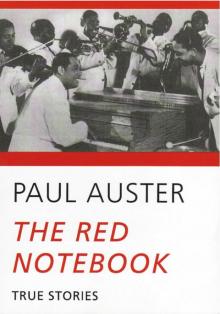
You mustn’t neglect to mention that you nearly choked to death on a fish bone in 1971 or that you narrowly escaped killing yourself in a dark hallway one night in 2006 when you smashed your forehead into a low door frame, stumbled backward, and then, trying to regain your balance, pitched forward, snagged your foot on the sill, and went flying face-first onto the floor of the apartment you had entered, the top of your head landing within inches of a thick table leg. Every day, in every country around the world, people die from falls like that one. Your friend’s uncle, for example, the same man you wrote about nineteen years ago (The Red Notebook, Story No. 3), who survived gunshot wounds and multiple dangers as a partisan resistance fighter against the Nazis in World War II, a young man who managed to escape certain death and/or mutilation with dumbfounding regularity, and then, having moved to Chicago after the war, living in the tranquility of peacetime America, far from the battlefields and flying bullets and exploding land mines of his youth, awoke one night to go to the bathroom, tripped over a piece of furniture in the darkened living room, and died when his head smashed into a thick table leg. An absurd death, a nonsensical death, a death that could have been yours five years ago if your head had landed just a few inches to the left, and when you think about the ridiculous ways in which people can meet their end—tumbling down flights of stairs, slipping off ladders, accidentally drowning, being run over by cars, shot by stray bullets, electrocuted by radios that fall into bathtubs—you can only conclude that every life is marked by a number of close calls, that everyone who manages to reach the age you have come to now has already wriggled out of a number of potentially absurd, nonsensical deaths. All in the course of what you would call ordinary life. Needless to say, millions of others have confronted far worse, have not had the luxury of leading an ordinary life, soldiers in combat, for example, civilian casualties in wars, the murdered victims of totalitarian governments, and the countless many who have perished in natural disasters: floods, earthquakes, typhoons, epidemics. But even those who manage to survive catastrophe are no less prey to the whims of daily existence than those of us who have been spared such horrors—as with your friend’s uncle, who eluded death in battle and died one night in a Chicago apartment on his way to the bathroom. In 1971, the fish bone lodged itself at the base of your throat. You were eating what you thought was a fillet of halibut, and for that reason you were not worried about encountering any bones, but suddenly you could no longer swallow without pain, something was in there, and none of the traditional remedies did the least bit of good: drinking water, eating bread, trying to pull the bone out with your fingers. The bone had traveled too far down your throat, and it was long enough and thick enough to have pierced the skin on both sides, and each time you made another attempt to cough it up, your saliva was mixed with blood. It was April or May, you had been living in Paris for two or two and a half months, and when it became clear that you would not be able to get rid of the bone yourself, you and your girlfriend left your apartment on the rue Jacques Mawas and walked to the nearest medical facility in the neighborhood, l’Hôpital Boucicaut. It was eight or nine o’clock in the evening, and the nurses had no idea what to do with you. They squirted a liquid numbing agent down your throat, they chatted with you, they laughed, but the stuck bone was inaccessible and therefore could not be extracted. Finally, at around eleven o’clock, the nighttime emergency doctor came on duty, a young man by the name of Meyer, yet one more Israelite in this neighborhood once inhabited by the blind piano tuner, and lo and behold, this young doctor, who couldn’t have been more than four or five years older than you were, turned out to be an ear, nose, and throat specialist. After you spat up some blood for him during the preliminary examination, he told you to follow him through the courtyard to his private office in another one of the hospital’s pavilions. You sat down in a chair, he sat down in a chair, and then he opened a large leather case filled with thirty or forty sets of tweezers, an impressive array of shining silver instruments, tweezers of every possible size and configuration, some with straight ends, some with curved ends, some with hooked ends, some with twisting ends, some with looping ends, some short and some long, some so intricate and bizarre-looking that you could not imagine how such things could travel down a person’s throat. He told you to open your mouth, and one by one he gently guided various sets of tweezers into and down your gullet—so far down that you gagged and spat up more blood each time he pulled another one out. Patience, he said to you, patience, we’re going to get it, and then, on the fifteenth try, using one of the largest pairs of tweezers, the grandfather pair with a grotesquely exaggerated scimitar of a hook at the end, he finally got a purchase on the bone, clamped down on it, wiggled it back and forth to free the points that were embedded in your flesh, and slowly lifted it up through the tunnel of your throat and out into the open air. He looked both pleased and astonished. Pleased by his success, but astonished by the size of the bone, which was a good three or four inches long. You were astonished as well. How could you have swallowed such a massive object? you asked yourself. It reminded you of an Eskimo sewing needle, a whalebone corset stay, a poison dart. “You’re lucky,” Dr. Meyer said, still looking at the bone as he held it up in front of your face. “This one easily could have killed you.”
* * *
No snow of any significance since the night of February first, but a frigid month with little sun, much rain, much wind, hunkered down in your room every day writing this journal, this journey through winter, and now into March, still cold, still as cold as the winter cold of January and February, and yet every morning you go outside to peruse the garden now, looking for a sign of color, the smallest tip of a crocus leaf jutting from the ground, the first dab of yellow on the forsythia bush, but nothing to report so far, spring will be coming late this year, and you wonder how many more weeks will go by before you can begin searching for your first robin.
* * *
The dancers saved you. They are the ones who brought you back to life that evening in December 1978, who made it possible for you to experience the scalding, epiphanic moment of clarity that pushed you through a crack in the universe and allowed you to begin again. Bodies in motion, bodies in space, bodies leaping and twisting through empty, unimpeded air, eight dancers in a high school gym in Manhattan, four men and four women, all of them young, eight dancers in their early twenties, and you sitting in the bleachers with a dozen or so acquaintances of the choreographer’s to watch an open rehearsal of her new piece. You had been invited by David Reed, a painter you met on the student ship that took you to Europe in 1965, now your oldest friend in New York, who had asked you to come because he was romantically involved with the choreographer, Nina W., a woman you did not know well and whose affair with David did not last long, but, if you are not distorting the facts, you believe she had started out as a dancer in Merce Cunningham’s troupe, and now that she had turned her energies to choreography, her work bore some resemblance to Cunningham’s: muscular, spontaneous, unpredictable. It was the darkest moment of your life. You were thirty-one years old, your first marriage had just cracked apart, you had an eighteen-month-old son and no regular job, no money to speak of, grinding out your meager, inadequate living as a freelance translator, author of three small books of poetry with at most one hundred readers in the world, padding your pittance of an income by writing critical pieces for Harper’s, the New York Review of Books, and other magazines, and apart from a pseudonymous detective novel you had written the previous summer in an effort to generate some cash (which still had no publisher), your work had staggered to a halt, you were stuck and confused, you had not written a poem in more than a year, and you were slowly coming to the realization that you would never be able to write again. Such was the spot you were in that winter evening more than thirty-two years ago when you walked into the high school gym to watch the open rehearsal of Nina W.’s work in progress. You knew nothing about dance, still know nothing about dance, but you have always responded to it with a soaring inner happiness whenever you see it done well, and as you took your seat next to David, you had no idea what to expect, since at that point Nina W.’s work was unknown to you. She stood on the gym floor and explained to the tiny audience that the rehearsal would be divided into two alternating parts: demonstrations of the principal movements of the piece by the dancers and verbal commentary from her. Then she stepped aside, and the dancers began to move around the floor. The first thing that struck you was that there was no musical accompaniment. The possibility had never occurred to you—dancing to silence rather than to music—for music had always seemed essential to dance, inseparable from dance, not only because it sets the rhythm and speed of the performance but because it establishes an emotional tone for the spectator, giving a narrative coherence to what would otherwise be entirely abstract, but in this case the dancers’ bodies were responsible for establishing the rhythm and tone of the piece, and once you began to settle into it, you found the absence of music wholly invigorating, since the dancers were hearing the music in their heads, the rhythms in their heads, hearing what could not be heard, and because these eight young people were good dancers, in fact excellent dancers, it wasn’t long before you began to hear those rhythms in your head as well. No sounds, then, except the sounds of bare feet thumping against the wooden floor of the gym. You can’t remember the details of their movements, but in your mind you see jumping and spinning, falling and sliding, arms waving and arms dropping to the floor, legs kicking out and running forward, bodies touching and then not touching, and you were impressed by the grace and athleticism of the dancers, the mere sight of their bodies in motion seemed to be carrying you to some unexplored place within yourself, and little by little you felt something lift inside you, felt joy rising through your body and up into your head, a physical joy that was also of the mind, a mounting joy that spread and continued to spread through every part of you. Then, after six or seven minutes, the dancers stopped. Nina W. stepped forward to explain to the audience what they had just witnessed, and the more she talked, the more earnestly and passionately she tried to articulate the movements and patterns of the dance, the less you understood what she was saying. It wasn’t because she was using technical terms that were unfamiliar to you, it was the more fundamental fact that her words were utterly useless, inadequate to the task of describing the wordless performance you had just seen, for no words could convey the fullness and brute physicality of what the dancers had done. Then she stepped aside, and the dancers began to move again, immediately filling you with the same joy you had felt before they’d stopped. Five or six minutes later, they stopped again, and once more Nina W. came forward to speak, again failing to capture a hundredth part of the beauty you had just seen, and back and forth it went for the next hour, the dancers taking turns with the choreographer, bodies in motion followed by words, beauty followed by meaningless noise, joy followed by boredom, and at a certain point something began to open up inside you, you found yourself falling through the rift between world and word, the chasm that divides human life from our capacity to understand or express the truth of human life, and for reasons that still confound you, this sudden fall through the empty, unbounded air filled you with a sensation of freedom and happiness, and by the time the performance was over, you were no longer blocked, no longer burdened by the doubts that had been weighing down on you for the past year. You returned to your house in Dutchess County, to the downstairs workroom where you had been sleeping since the end of your marriage, and the next day you began to write, for three weeks you worked on a text of no definable genre, neither a poem nor a prose narrative, attempting to describe what you had seen and felt as you’d watched the dancers dance and the choreographer talk in that high school gym in Manhattan, writing many pages to begin with and then boiling them down to eight pages, the first work of your second incarnation as a writer, the bridge to everything you have written in the years since then, and you remember finishing during a snowstorm late one Saturday night, two o’clock in the morning, the only person awake in the silent house, and the terrible thing about that night, the thing that continues to haunt you, is that just as you were finishing your piece, which you eventually called White Spaces, your father was dying in the arms of his girlfriend. The ghoulish trigonometry of fate. Just as you were coming back to life, your father’s life was coming to an end.
* * *
In order to do what you do, you need to walk. Walking is what brings the words to you, what allows you to hear the rhythms of the words as you write them in your head. One foot forward, and then the other foot forward, the double drumbeat of your heart. Two eyes, two ears, two arms, two legs, two feet. This, and then that. That, and then this. Writing begins in the body, it is the music of the body, and even if the words have meaning, can sometimes have meaning, the music of the words is where the meanings begin. You sit at your desk in order to write down the words, but in your head you are still walking, always walking, and what you hear is the rhythm of your heart, the beating of your heart. Mandelstam: “I wonder how many pairs of sandals Dante wore out while working on the Commedia.” Writing as a lesser form of dance.