Dr no, p.1
Dr. No, page 1
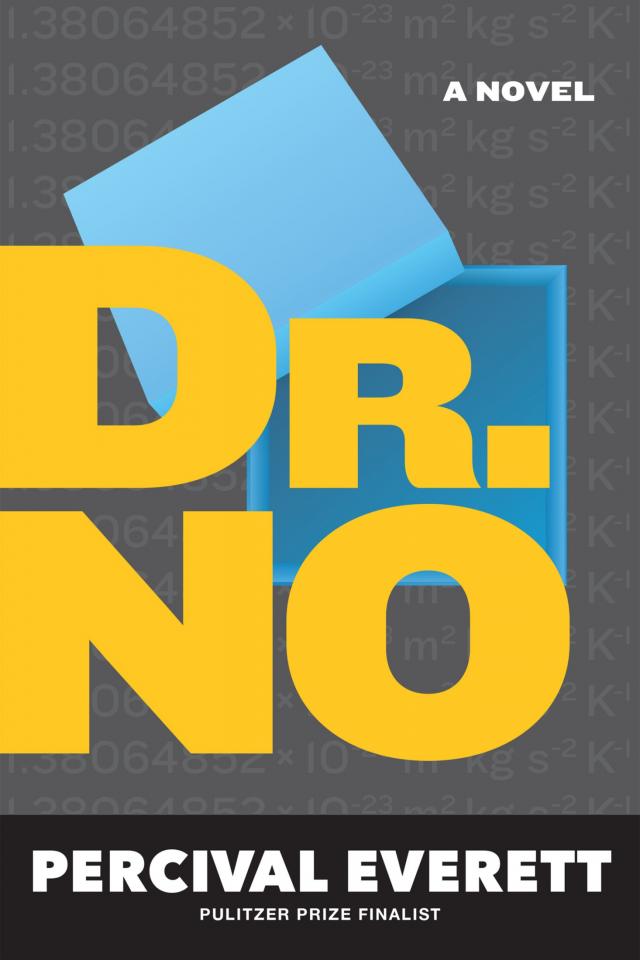


DR. NO
Also by Percival Everett
The Trees
Telephone
The Book of Training by Colonel Hap Thompson of Roanoke, VA, 1843: Annotated from the Library of John C. Calhoun
So Much Blue
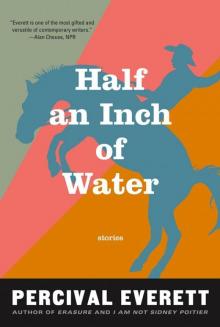
Half an Inch of Water
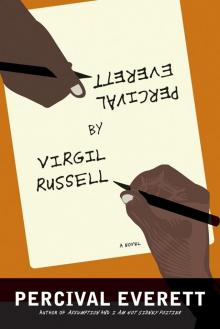
Percival Everett by Virgil Russell
Assumption
I Am Not Sidney Poitier
The Water Cure
Wounded
American Desert
A History of the African-American People [Proposed] by Strom Thurmond as Told to Percival Everett and James Kincaid
Damned If I Do
Grand Canyon, Inc.
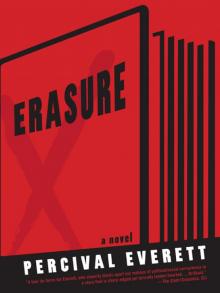
Erasure
Glyph
Frenzy
Watershed
Big Picture
The Body of Martin Aguilera
God’s Country
For Her Dark Skin
Zulus
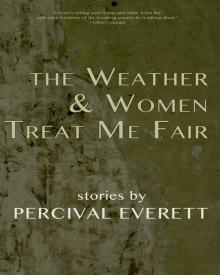
The Weather and Women Treat Me Fair
Cutting Lisa
Walk Me to the Distance
Suder
The One That Got Away
re: (f) gesture
Abstraktion und Einfühlung
Swimming Swimmers Swimming
Trout’s Lie
DR. NO
A Novel
Percival Everett
Graywolf Press
Copyright © 2022 by Percival Everett
The author and Graywolf Press have provided this e-book to you for your personal use only. You may not make this e-book publicly available in any way. Copyright infringement is against the law. If you believe the copy of this e-book you are reading infringes on the author’s copyright, please notify Graywolf Press at: us.macmillanusa.com/piracy.
This publication is made possible, in part, by the voters of Minnesota through a Minnesota State Arts Board Operating Support grant, thanks to a legislative appropriation from the arts and cultural heritage fund. Significant support has also been provided by the McKnight Foundation, the Lannan Foundation, the Amazon Literary Partnership, and other generous contributions from foundations, corporations, and individuals. To these organizations and individuals we offer our heartfelt thanks.
Published by Graywolf Press
212 Third Avenue North, Suite 485
Minneapolis, Minnesota 55401
All rights reserved.
www.graywolfpress.org
Published in the United States of America
ISBN 978-1-64445-208-0 (paperback)
ISBN 978-1-64445-191-5 (ebook)
2 4 6 8 9 7 5 3 1
First Graywolf Printing, 2022
Library of Congress Control Number: 2022930735
Cover design: Kapo Ng
For my editor, accomplice, and dear friend, Fiona.
Thank you for our twenty-seven years together.
Don’t go around saying the world owes you a living.
The world owes you nothing. It was here first.
—Mark Twain
DR. NO
Existential quantifier
1
I recall that I am extremely forgetful. I believe I am. I think I know that I am forgetful. Though I remember having forgotten, I cannot recall what it was that I forgot or what forgetting feels like. When I was a kid, my mother tried to convince me that I was forgetful by saying, “Do you remember when you forgot your own birthday?” I think I replied, “How could I?” But it was a trick question. Saying yes would have been an admission of my forgetfulness and saying no would have been an example. “The brain does what it can,” I told her. If we remembered everything, we would have no language for remembering and forgetting. As well, nothing would be important. In fact, nothing is important. The importance of nothing is that it is the measure of that which is not nothing. Is nothing the same as nothingness? Students love to imagine such things. There is in fact no nothing; the simplistic argument for this assertion is that the observation of nothing requires an observer, and so the presence of the onlooker negates what might have been pure absence, what might have actually been nothing. If nothing falls in a forest and there is no one around to observe it, does it make a nil? The better argument, one that embodies the simple one and any other, is that one can spell nothing. Parmenides might have been a shabby dresser, but he had a point. The ontological argument might not have worked for the existence of God, but it is indisputable for the existence of nothing. Ei mitään, rien, nada, nicht, nic, dim byd, ikke noget, ingenting, waxba, tidak ada, boten, apa-apa, kitn, nihil, and nenio. Kind of an ontological argument for the existence of nothing.
My name is Wala Kitu. Wala is Tagalog for nothing, though I am not Filipino. Kitu is Swahili for nothing, though my parents are not from Tanzania. My parents, both mathematicians, knew that two negatives yield a positive, therefore am I so named. I am Wala Kitu. That is all bullshit, with a capital bull. My name is Ralph Townsend. My mother was an artist, my father was an English professor who ended up driving a taxi. I am, in fact, a mathematician of a sort. But I use the name Wala Kitu. I study nothing.
I am serious about my study. I am a distinguished professor of mathematics at Brown University, though I have not for decades concerned myself with arithmetic, calculus, matrices, theorems, Hausdorff spaces, finite lattice representations, or anything else that involves values or numbers or representations of values or numbers or any such somethings, whether they have substance or not. I have spent my career in my little office on George Street in Providence contemplating and searching for nothing. I have not found it. It is sad for me that the mere introduction to my subject of interest necessarily ruins my study. I work very hard and wish I could say that I have nothing to show for it.
It was my expertise in nothing, not absolutely nothing, but positively nothing, that led me to work with, rather for, one John Milton Bradley Sill, a self-made billionaire with one goal, a goal that might have been intriguing to some, confounding and weird to most, idiotic to all, but at least easily articulated. John Milton Bradley Sill aspired to be a Bond villain, the fictitious nature of James Bond notwithstanding. He put like this: “I want to be a Bond villain.” Simple.
We were sitting in a coffee shop on Thayer Street. It was eight on a Monday morning in November, the semester winding down and so the students who had dragged themselves in there were nearly sleepwalking. I was much like them. I had discovered only recently that I needed a full twelve hours of sleep to function properly but had sat up much of the night thinking about the meeting with Sill. I hardly ever remembered my dreams, which seemed right and fair as I rarely recalled my waking life during sleep.
“What do you mean by Bond villain?”
Sill held a spoon like a cigarette. “You know, the sort of perpetrator of evil deeds that might cause the prime minister to dispatch a double-naught spy to thwart me. You know, evil for evil’s sake.”
“A sort of modernist villain,” I said.
“Precisely.”
I stared and stirred my tea. I didn’t want to look at him, but I did, realizing, as he came into focus, that he was certifiable. But jolly. He was a pleasant-looking fellow, slightly racially ambiguous, an equine face and tightly curled hair. He was a slight man. “You look too nice to be a villain,” I said.
“Thank you,” he said. “Appearances are only that.”
“Have you ever performed an evil deed?”
“Like what?”
“Have you ever killed anyone?” I asked. “Bond villains kill indiscriminately.” I was speaking out of my ass. I didn’t know the first thing about Bond villains.
“Some do, some don’t.” Sill poked the air with his spoon. “Have you ever seen Goldfinger?”
“I think so. Let’s say no.”
“Goldfinger robs Fort Knox.”
“Where they keep the gold,” I said.
“Where they keep the gold.” John Sill looked around, measuring everyone in the room. “Do you know what’s actually in the vault of Fort Knox?”
“I don’t.”
He leaned forward, actually resting his chin on the palm of his hand, like a lover or at least like someone who had known me for more than a quarter hour, and said, “Nothing.”
“You mean there is no gold there.”
“I mean there is nothing there.”
“Nothing,” I said.
“Precisely that. I am not telling you that there is no gold there. I’m telling you that there is nothing there. What you have been looking for.”
The hair on the back of my neck stood up. Still, I was convinced he meant that the vault was empty.
“I’m telling you that the vault is not empty.” As if reading my mind.
“And?”
“You, my friend, are going to help me steal it. I’ve done my research. You know more about nothing than anyone. How much power must there be for anyone who can possess nothing.”
“Listen, I’m flattered,” I said, “but—”
He silenced me by lifting his hand from mine and holding it ominously in the air between us. “You won’t have to do a damn thing. All I want from you is an ongoing consult. Answers to a few questions. For example, when I open the vault, and I will, how will I know that nothing is there? It’s a big vault. If it is full of nothing, then how will I move it? How does one transport such a thing? Does it need to be refrigerated at minus 273 degrees Celsius?”
“You’re serious,” I said. “Which is not so different from ‘you’re crazy.’”
“I am that,” John Sill said. Another glance around and he pushed a yellow slip of paper toward me.
&n bsp; It was a check. A check with many zeros before the meaningless decimal point. It was a cashier’s check issued by the Bank of America.
“This is real,” I stated, but it was really a question.
Sill nodded. “All you have to do is advise me, answer my questions about nothing and not with some off-the-cuff shit that you save for graduate students and panels. I can get that shit from anyone. I can get that from any number of books. I want your pure, honest confusion.”
“Anything else?”
“Of course, this is to remain confidential. I mean, really confidential, really, really confidential.” He caught my eyes with his and for a flashing second he looked like the Bond villain he aspired to be. He scared me for that briefest moment. “Okay? Wink, wink, Bob’s your uncle.”
“Understood.”
“So, you on board?”
“This is for me?” I shook the check as if to see if the writing might fall off.
“That’s your name on it.”
Indeed it was. Spelled correctly and everything. All in black ink. What else could I say, but “Okay.”
I left the coffee shop $3 million heavier and also with the belief that, although crazy, John Sill might have been correct about the military possession of nothing. There was a credible faction of the military complex that believed as I did that nothing was the solution to everything. Where my notion of solution was heuristic, the generals’ notion was gladiatorial, bellicose, not nice. None of us knew just what nothing was, but its possibilities were boundless; that much was a logical necessity and therefore true. I recalled being approached some years earlier by two generals from the army whose names I might have heard but certainly didn’t remember. I did remember that they looked alarmingly similar, though one was a woman and the other a man. They knocked on my office door, timidly, it seemed, for warmongers.
We discussed nothing in a roundabout, yet truthful way for just more than two hours. They wouldn’t tell me what they wanted it for and I couldn’t tell them what it was or where to find it.
“What do you think you can do with nothing if you find it?”
“That’s why we’re talking to you,” said General He. “We’d very much like to know, you know?”
“You know nothing,” from General She. “That is widely accepted. We want your help. Don’t you want to serve our country?”
“I’ve given this country nothing my entire life. I don’t plan to change now.”
“What do you mean?” from She.
“I didn’t mean anything by that,” I said. “Not anything is not equivalent to nothing. You understand that, right?”
“Nothing could make all the difference in the world, we know that much,” said General He.
I shook my head. “No one can possess nothing.”
The generals shared a look that I didn’t understand, in fact their shared look did not even register with me until that day as I walked home from my meeting with John Sill. Perhaps someone could find and harness nothing. I felt a little sick to my stomach, fearful, and somewhat giddy with excitement.
It is postulated that before the so-called Big Bang (like many, I imagine that it was more likely a whimper) the primordial constituent elements were things like helium-4, helium-3, deuterium, and protium. The sophomoric question, but no less vexing for that quality, is where did that stuff come from? And just what is the universe expanding into, through, and/or toward? It is either nothing or a something we call nothing and not that dark-matter bullshit that so many buy into. The theory was not my own, but that of a rather weaselly speculative French physicist named Jean Luc Retàrd, yes, who applied the notion of Riesz spaces and the idea of abstracting the order properties to free continuous functions from the details of any particular space, leading to the thought that if nothing actually comes into contact with something, or non-nothing, then that something will cease to exist. One can see the parabellum implications without much use of an imagination. Most believe, wrongly, that nothing is merely the emptiness between subatomic particles. Nothingness is not emptiness any more than it is the absence of something, some thing, some things or substance. The actual Big Bang is coming, as what the universe came from is catching up to what it will become. To experience the power of nothing would be to understand everything; to harness the power of nothing would be to negate all that is, and the sad, scary, crucial idea here is that this might well be a distinction without a difference.
My dog met me at the door. He had no choice. That was where I had left him. His name is Trigo and he has but one leg. He is a stout, squat bulldog, even squatter given his missing legs. Trigo refers to his three missing limbs as his nothings. I rescued him, that was the language of the shelter, “rescued,” though I prefer “befriended.” The workers at the shelter were about to “put him down,” their euphemism for murder. I asked if they would kill a person with no legs and they of course said no. I took the dog and his one remaining leg away from that place. Twice a day, when he decides, he does his business and I clean him postwaste. He has a wheelie-cart that he doesn’t much like but does pull around for about fifteen minutes in the morning for a bit of exercise. When I take him out for air, he rides on my chest in a baby carrier called a Björn. He is an extremely friendly, if discerning, very jowly, very vocal dog. He speaks to everyone.
Trigo and I walked down the hill to the center of Providence and to the Bank of America, where I stood in line to deposit the check from John Sill.
The stunned teller stared at the face of the check for a full minute. “This looks real,” he said.
“I suppose that’s because it is,” I said.
“Wait here,” he said.
“Is there a problem?”
“I have to get this okayed by my supervisor.”
“Sounds reasonable,” I said.
His name was Theodore, I learned this from his nameplate, black with brass letters. He stepped away some feet and spoke to a smarter-looking young woman. He showed her the check. She looked past him at me, then again at the paper, held it to the light. They both walked back to me.
“Is there a problem?” I asked.
“I don’t know,” the woman said.
“What’s your name?” I asked.
“Stephanie Mayer,” she said.
“My name is Wala Kitu. It’s printed right there on the face of the check. It’s also printed here on my government-issued passport and again here on my faculty ID and also here above my address on the deposit slip ripped cleanly from my Bank of America checkbook. This is Trigo. He has no ID.”
Trigo barked.
People in the adjacent lanes were staring now. The lanky custodian had stopped dusting the floor and looked on as well. Stephanie Mayer initialed the check and gave Theodore the go-ahead. I took my deposit receipt and gave it a close inspection, counting the zeros, and nodded, contemplated seeking out Stephanie Mayer’s permission to leave, but didn’t.
Outside I stumbled into one of my colleagues, a very young mathematician named Eigen Vector. Her specialty was topology, what else? Like most mathematicians, including me, she fit somewhere on the spectrum and was likely to say nearly anything and so she did.
“My shoes match today,” she said as a greeting.
I looked at her Nike sneakers. “Two of them,” I said.
“Hello, Trigo,” she said.
Trigo spoke.
Eigen attempted a bark herself.
“Beautiful day,” I said, noticing as I spoke that the sky was overcast and everything was gray.
“I suppose it is,” she said. “Why are you so happy? I ask because you seem happy. I’d like to experience happiness.”
“I don’t think I’m ever happy, to tell the truth,” I said. “Not really sad ever, but not happy.”
“Well, you seem happy.”
“Who knows, maybe I am,” I said. “I wouldn’t know what it feels like. Trigo, now he’s happy.”
Trigo spoke.
Eigen Vector stroked his fat, flat face with the back of her hand. “Soft. So very soft. Fat face.”
“He’s happy because he still has one leg left.”
“I would like my life to be symmetric,” Eigen said. “Symmetrical? But I can’t seem to make it equal its own transpose.”