The talosite, p.1
The Talosite, page 1
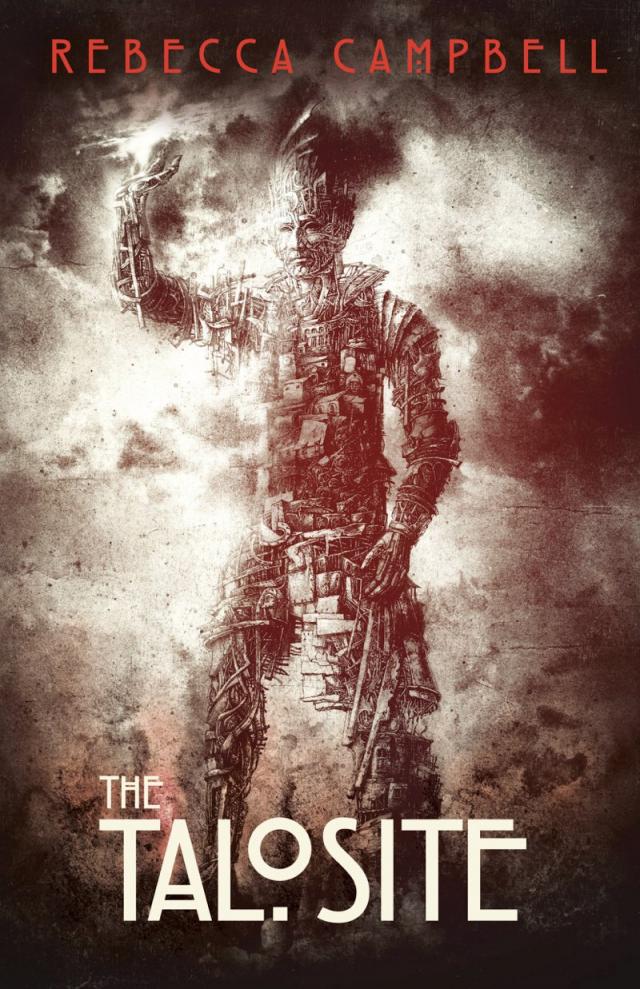


THE TALOSITE
ALSO BY REBECCA CAMPBELL
Arboreality
The Paradise Engine
THE TALOSITE
REBECCA CAMPBELL
THE TALOSITE
Copyright © 2022 by Rebecca Campbell
Cover art by Yaroslav Gherzedovich
Cover design by Vince Haig
Interior cover art © Rawpixel
Interior design and layout by Michael Kelly
Proofreader: Carolyn Macdonell-Kelly
First edition
All rights reserved.
The publisher gratefully acknowledges the support of the Ontario Arts Council.
Library and Archives Canada Cataloguing in Publication
ISBN: 978-1-988964-40-9
This book is a work of fiction. Any resemblance to actual events or persons is entirely coincidental.
Undertow Publications, Pickering ON, Canada
No part of this book may be reproduced in any form or by any electronic or mechanical means, including information storage and retrieval systems, without written permission from the publisher, except for the use of brief quotations in a book review.
Typeset in Athelas
Printed in Canada by Rapido Books
For Don
PRAISE FOR THE TALOSITE
“The Talosite is further proof Campbell is a supremely gifted writer. She’s invented a strange, dark, compelling, and poignant alternative world in which the dead can be resurrected. An absolute must read!”
PAULA GURAN, YEAR’S BEST DARK FANTASY & HORROR
“Campbell captures the perfect voice in this deftly crafted alternate history that explores wonders and horrors and the blurred space where they bleed into one.”
A.C. WISE, AUTHOR OF THE GHOST SEQUENCES
“An intricate false history of WWI, an emotional and stylish reimagining of Frankenstein and reanimation legends, The Talosite fixedly explores the unfathomability of both love and mass death.”
NABEN RUTHNUM, AUTHOR OF HELPMEET
La victoire avant tout sera
De bien voir au loin
De tout voir
De près
Et que tout ait un nom nouveau
GUILLAUME APOLLINAIRE, “LA VICTOIRE,” 1917
CONTENTS
I. Autumn 1916
1. Ned
2. Anne
3. Ned
4. Anne
5. Ned
6. Anne
II. Summer and Autumn 1918
1. Anne
2. Ned
3. Anne
4. Ned
5. Anne
6. Anne and Ned
7. The Talosite
Acknowledgements
About the Author
PART I
AUTUMN 1916
1
NED
Ned’s first thought was giant, like the giants of Potsdam that Franky had warned him about. Eight-foot Prussians. Kill you when they fall as much as when they jab you or shoot you through the eye. Marksmen, too, the advantage of height. Franky was a barrack room lecturer and often held forth as Ned listened, by turns shocked and amused by all the things he had not known about the world until he arrived in France the year before.
This Potsdam Giant stalked toward them, lit first by moonlight, then by flares.
“He must be seven feet tall,” Franky said. “Look at the bugger. Seven feet?”
But what was he doing in the moonlight like that? A death wish.
“Bernard will get him, don’t worry,” Franky said.
Across the mud, German voices raised in admonition, then panic. “Kommzuruck! Kommzuruck!”
Halfway now. Taller and taller.
“Bernard has him,” Franky said. “Eight feet? Is he eight?”
More shouting on the other side, and shuffling activity up and down the trench. In the moonlit shadows he could imagine a helmet raised, a scope. More shouting. Another flare.
Now the Giant was close enough to see a face beneath the helmet, or at least its lineaments. “More than eight feet,” Franky said. “Is the blighter more than nine?”
Then Bernard, in his sniper’s blind down the trench, did his duty. A ring, a ricochet. The Giant stumbled.
“Bernie!” Franky said. “Good lad. Good lad.”
The Giant staggered up again, his arm limp. Still stalking fearlessly toward them.
“They’re like locomotives, aren’t they, giants. Too bad we don’t have more like him. Need Irish giants. You know, the giant—”
—Another shot—
“—O’Brien. We want his kind. Could take a step—”
—Another shot. The Giant fell twenty feet from their position. Ned could make out the whole man’s length. At least eight feet.
“—and be in the middle of that trench. Could stand up here and piss on their goddamn square heads. His cock was—” here he grunted and waggled his forearm obscenely.
Across the mud, the Germans had settled down, though Ned still sensed the same scurrying activity, the muttered grunts and gutturals, which he did not understand, but which he hated.
In that night’s wiring party, he crept over the parapet and into the open, swampy world, as fear galvanized his skin and knotted his guts around his heart. He had a line of wire to cut east-north-east of their position, which took him within a few feet of the Giant. He wriggled over the lip of a shell hole, or perhaps the parapet of an earlier trench, or the body of a horse entangled with the wagon it had pulled to this place in 1914, before expiring in a shower of earth and shrapnel. Or it might be some ancient garden wall. One never knew. He looked down the slight incline to find the Giant closer than he had reckoned. His right arm sprawled toward Ned, naked and rotted and scarred, its skin pale and crossed by the white fuzz of decay far more advanced than he expected in one who had died the day before. He crept forward again, and by the light of flares could see the man’s face.
Another flare and he thought the Giant twitched. For the first time in a week of bombardment, and the miserable wait for combat, Ned felt a new kind of fear. He told himself that flares and no-man’s-land will do strange things to soldiers’ eyes. But then the Giant twitched again.
He had to think: did one rescue the monstrous German stranger, or did one abandon him to the deepening mud?
He grabbed the Giant’s arm and pulled, saying, “come on you bastard, come on. Schnell!”
Something snapped inside the German, and the arm tore loose at a kind of seam on the bicep, trailing tendons and muscle into the mud. The hand in Ned’s hand stopped twitching. The body it had been attached to did not.
Then the whistle of a flare overhead, sparks descending. He pressed himself into the mud, still holding the disembodied hand, knowing that twenty feet away the Hun rose. The first shot. The second. He cursed the early education in self-sacrifice that had led him to reach his hand out to the Giant. He cursed the providence that had led him to this spot in the first place, and the war itself, as the Hun approached, faceless creepers as the flares continued their descent.
A spray of machine gun fire from the Canadians. Bernard. Franky. He willed himself to total stillness and in the darkness that followed the flare, he could not tell whether the German soldiers had crept back in their trench or were pressed, as he was, against the forsaken earth. Then someone was beside him, not Franky nor Bernard nor sarge: too clean to be one of theirs. The unusually clean man said, “may I?” and took the Giant’s hand from his—he wasn’t aware that he still held it—then shoved him back toward his trench.
The gentleman who interviewed him at HQ was Captain Beauchamp. He was English, with a small moustache in the manner of English officers, and neither cap badge, nor insignia, though his buttons showed phoenixes. They sat at a bare table, requisitioned from some farmhouse, Ned guessed, tracing with his eyes the patina of bread-making and vegetable peels. “Now,” said Captain Beauchamp, “You found the soldier dead the next day.”
“Yessir. Or. No sir. In the flares it’s hard to say. He’d been there two days. But I would swear I saw him twitch.”
The man wrote a line in his gilt-edged notebook, asking Ned to repeat details. It was ten minutes before he could ask, “Did you get the Potsdam Giant?”
“The—what?”
“Potsdam Giant.” He repeated. “What Franky called it, sir.”
“Franky? Oh. Yes. Private Goble. We got what was left of it. If we’d heard sooner, we would have had more. Rats are a problem.”
Franky had lost his leg getting the Giant those fifteen feet back to the trench. Ned never saw him again. “What was he?” Ned corrected: “it?”
“A Potsdam Giant, obviously. Prussians are quite tall.” Ned knew it was bunk, but the man had a posh accent and a neatly clipped blond moustache, and his hands were very brown and very clean. “We’ll want you to talk to one of our clerks if you can be spared.”
“Yessir,” Ned said. That was a stupid way to put it. Everyone could be spared. No one could.
Still, it meant a few hour’s quiet up the line. Not as far up the line as he had expected, though. They were in one of the large, sprawling villas outside Paris, out of range of the shelling, but not the noise. When he saw it at a distance, he thought it must be a casualty clearing station built around a villa of great beauty and decrepitude, though he could not say why the staff at a clearing station would be so interested in the Potsdam Giant. While he waited inside what had been a handsome foyer, he saw a girl, young-looking, in a patch of light at the end of the hallway
When she was gone, he saw a filament catch the light, a long hair that hung from the door jam, reflecting green like verdigris. He caught it. Wondered. Dropped it. And then continued along the corridor where he had been sent, a small room requisitioned from the earlier inhabitants of the villa. He could see from the upper windows the treeless dark of no-man’s-land, a smudge on the eastern horizon. Another table, from another farmhouse kitchen, where he repeated his story in greater detail, punctuated by further questions regarding the reaction of the German side of the trench, and the way the Giant moved. When the man’s questions were exhausted, and Ned no closer to understanding what he’d seen, his interrogator paused.
“Do you think,” he began, “that if you saw another—what did you say—Potsdam Giant—you would recognize it?” When Ned nodded, the man added, “What would you think of joining the stretcher bearers?”
“I don’t know, sir.”
“You’d be in a good position there, to keep watch for giants. You’re no doubt aware of automata?”
“Yessir. I suppose, sir. But mostly in stories.”
“The Hun have innovated. Improved on nature and made automata like your Giant, which are rather more useful in the battlefield than the old-fashioned kind. That one was the first we’ve captured alive, but there are more coming, and we need to find them. We are in need of eyes. Stretcher bearers make good eyes.”
And so, through little effort and no design of his own, Edward Wallace’s future was settled.
2
ANNE
In March 1916, Anne Markham was in Manchester, twenty-one and far from the home in London she had once shared with her father. Her fingernails had been brightly yellow, the colour of ducklings and daffodils. Her hair was green shot through with copper, which she considered an improvement on her usual pale brown. The new colour had come with her work in munitions and the interaction between keratin and trinitrotoluene, but the effect was so strange and spectacular that, on those rare occasions she looked in the mirror, she did not recognize the thin yellow creature she had become in her daily handling of TNT. Bomb-making was a job she had earned because her tiny, pointed fingers were clever at tiny, pointed tasks. Years of embroidery had given her skills she had not thought would be so useful during a global conflict, but this was total war and here she was, drinking tea in the early morning after her night’s labour, while first shift workers streamed through the street outside. The tea was weak. The bun stale. She was not yet ready to sleep, though Millicent had left their bed by now, and it would still be warm with her nighttime perfume: Quelques Fleurs sprinkled over her chemise.
In the factory nearby, which Anne had so recently left, Millicent stepped into the still, hot room among the cordite and TNT, her hands as brilliantly yellow as Anne’s, her hair red-gold. Someone somewhere struck a spark from the unseen nail in her shoe, or an unnoticed hair pin, and the inferno was instant, spreading outward so quickly that the neurological signals of pain and heat had not yet reached Millicent’s brain when the shockwave blasted her bones. Her body evaporated.
The windows of the teashop shattered. With the broken glass came a new ringing in her ears that overwhelmed the sounds of the street. Outside, the crowd on the pavement stopped, looked up, then turned as one animal toward the factory gate. Joining them, Anne saw the familiar red smear of blood and her mind stopped, drifting in a slow-circulating spiral of a moment. Afterward, she could remember details: the broken bricks, the smashed teacup with the rose on it, the smudged blood drying where the girl’s eyes had been blown away. But she couldn’t have told anyone how long she had stood in the street, joining the crowd who excavated the factory in search of any survivors. Time must have passed. She must have walked home, because she found herself there at twilight, filthy, her fingernails broken.
That was six months ago, but the explosion still reverberated through her bones, as though it had not passed but happened in the war’s eternal now, which in two years had already driven her from her home and the old, orderly life she had lived with her father.
Now it was September 1916 and she was in France, her skin still faintly yellow, but the green and copper hair falling from her scalp. There was only one mirror in the villa they had commandeered; she avoided it, wrapped a white scarf around her head and pared her nails down to stubs. Then she set her mind to the work that had brought her to France in the first place: the creation of automata from the fallen soldiers of the western front, following the principles she had learned while assisting her father, the eminent experimental neurologist, Henry Markham. As he had done, she revived the bodies of the fallen with copper wire, aethereal fluids, the filaments of the fungus Armillaria lazarites, and electricity. Each creature required a corpse inoculated with lazarites shortly after death, then a web of wire stitched beneath its skin. Then the sudden shock of faradaic current, and the piecemeal neurological network fused into something new. What arose was no longer a man, but now an automatic soldier, suited to tasks that required strength and nervelessness, but unable to operate an Enfield. She saw them often, hauling artillery over rough ground or digging trenches. Their new lives were short, but they worked without sleep or food or speech until they stopped suddenly and absolutely, even if one reapplied current and copper wire.
She was good at this god-like tatting. Their lab was close enough to the line she could hear fire most nights, a necessary risk when they needed fresh bodies daily. Based on their most recent orders, she guessed they wanted automata they could set to walking over no-man’s-land, triggering mines to save a second and third and fiftieth wave of living troops. But as she worked, she often imagined other ways to fulfill the brief: perhaps squat creatures half the height of a man, creeping crab-wise, their femoral shafts replaced by steel, little Bosch demons scuttling through The Garden of Ordnance to the Garden of Combat. She had little luck building these more ambitious automata when the War Office wanted simple resuscitated bodies, and she had neither the time nor the resources to further her father’s experiments.
The day after the Declaration, Father had offered his services to the War Office, outlining the possibilities for combat automata. He had wanted her to continue as his assistant, but in an unusual act of rebellion, she had insisted on her own war work. All through September 1914 she had written letters and requested positions while Father sulked, silent at the breakfast table, testing the nerve responses in each of his toes with needles and ice. He shook his head when she took up the familiar tools and tried to do the job that had been hers for years. Beneath the pall of his silence, she packed a small bag and left for munitions training. She wasn’t there to look after him while his ankle healed from the sciatic procedure, which they’d undertaken together at the end of July. Despite the sulk, his letters had arrived regularly, more like reports than missives of fatherly affection, and she had kept them as records, still his secretary. When he wrote about an infection at the incision in his ankle, she left immediately, but he was dead before she arrived home.
Once, against Calloway’s wishes, she’d shown Captain Beauchamp her drawings. Bodies made for trenches and infantry raids, bodies without auditory nerves, untroubled by bombardment, with low centres of gravity and many short limbs that would allow them to roll with each shell blast. She had thought that they might be armoured, too, following the principles of the tortoise or pangolin. She had drawn long centipede-creatures using the spines of horses and the heads of men.