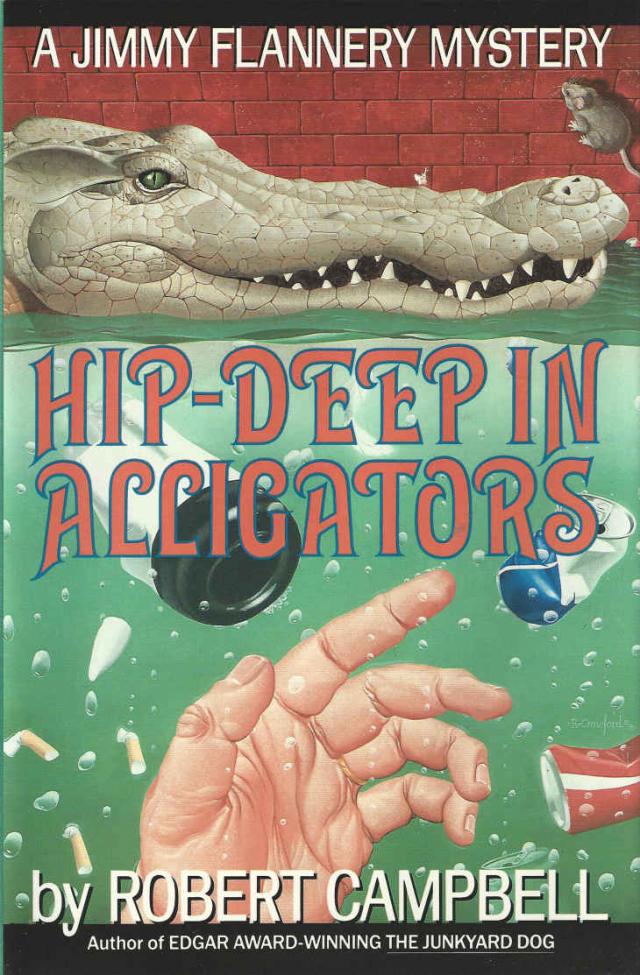
Hip deep in alligators, p.1
Hip-Deep in Alligators, page 1
part #3 of Jimmy Flannery Series


Contents
Praise
Title Page
Copyright
ONE
TWO
THREE
FOUR
FIVE
SIX
SEVEN
EIGHT
NINE
TEN
ELEVEN
TWELVE
THIRTEEN
FOURTEEN
FIFTEEN
SIXTEEN
SEVENTEEN
EIGHTEEN
NINETEEN
TWENTY
TWENTY-ONE
TWENTY-TWO
TWENTY-THREE
TWENTY-FOUR
TWENTY-FIVE
TWENTY-SIX
TWENTY-SEVEN
TWENTY-EIGHT
TWENTY-NINE
THIRTY
THIRTY-ONE
Praise for Robert Campbell
“Campbell writes with wit and vigor. The comparison not unflattering is to Elmore Leonard.”
—— Los Angeles Times
“Robert Campbell is an awfully good writer.”
—— Elmore Leonard
“Robert Campbell is one of the most stylish crime writers in the business.”
—— New York Times
Praise for Hip-Deep in Alligators
“What’s an alligator doing in the Chicago sewer system? The book is delightful largely because Campbell’s invention never fails him. He piles the absurd on the grotesque and makes it work.”
—— Newsday
Praise for The 600 Pound Gorilla
“From Robert Campbell, the author of The Junkyard Dog. . .We expect good writing, and the 600 Pound Gorilla does not disappoint. . .an expert piece of work in which wacky humor and high seriousness are palatably mixed.”
—— The New York Times Book Review
“Chicago is a better place because of Jimmy Flannery, a precinct captain in the 27th Ward. He is in politics to help his neighbors. . .a novel idea in the here-and-now.
——— Daily News
Praise for Edgar Award Winner
The Junkyard Dog
“Dialogue so breezy it stings your eyeballs,spirited characterizations of Jimmy’s proud ethnic neighbors, and the ward healer’s cocky defense of the old ways, the old politics . . . You can’t help liking Jimmy Flannery.”
—— New York Times Book Review
“This truly innovative private-eye character moves credibly through a brawling, tough-guy atmosphere in a plot that’s both twisty and witty.”
—— ALA Booklist
“Written in an appealing argot, this mystery has full characters, a satisfying ending and a nice balance of hardboiled action and romantic tenderness.”
—— Publishers Weekly
Hip-Deep in Alligators
Robert Campbell
Publisher’s Note
This book is a work of fiction. Names, characters, places, and incidents either are the product of the author’s imagination or are used fictitiously, and any resemblance to actual persons, living or dead is entirely coincidental.
Copyright © 1987 R. Wright Campbell
All rights reserved.
Cover Design © 2015 Ayeshire Publishing
ONE
My name is Jimmy Flannery.
Maybe you remember I had a little trouble last winter over a gorilla named Baby who's supposed to have killed two gay men, but didn't. And there's this Janet Canarias, a lipstick lesbian who ain't supposed to win the race for alderman in the Twenty-seventh, but does. Then there's my Chinaman, "Chips" Delvin, an old elephant with sore feet who offers to name me warlord, which is not the same thing as alderman, of the Twenty-seventh ward when he retires, but changes his mind so he can send me back down into the sewers, I should learn a lesson for standing up to the bosses.
I could tell you the whole story again, but if I do, it'll only make me weep. Suffice it to say that Mary Ellen Dunne, the lady that lives with me in my flat in a six-family on Polk Street, and my old man, Mike, stick by me through thick and thin. Now that I'm wading through the shit it's more like they're sticking with me through thick.
Janet Canarias goes to see Delvin, who's afraid she'll steal the job of Democratic ward boss from him, too, if he ain't careful. Also he's afraid that women, or at least persons what wear skirts, will take over the city if old elephants like him ain't around keeping watch.
Janet pleads with him on my behalf, but I could have told her, it does nobody any good.
He just tells her she's a very pretty girl who should give up her unnatural wicked ways and marry a nice Puerto Rican boy who'll give her babies.
Then she goes to make my case to Wally Dunleavy, Superintendent of Streets and Sanitation. I could also give her the word on him, but some people got to find things out for themselves.
He says to her not to worry, they don't intend to let me die of old age down there in the tunnels without ever seeing the light of day again, but the Party will have to decide when I should be let up for air.
She says to me, "It's a shame how these old men don't know they're dead."
"They know they're dying," I say.
"Then they shouldn't be knocking people around in their death throes."
"Elephants can do a lot of damage that way," I say, thinking that if Delvin or Dunleavy wanted to put me out on the streets, there was nobody who could help would want to, and those who would want to couldn't. Just like her.
She would've gone to see the mayor, but since she is one of the few independents who don't want to choose a side in the fight the mayor's having with the opposition, I told her to use her common sense. She ain't going to get no favors without doing favors. And she don't want to start trading favors so early in the game, because there's a big shake-up on the way and she don't want to be on the wrong side when the bricks start to fly. She sees the sense of what I tell her. It's only good politics.
At least that's what Mike says.
Personally, I don't really give a rat's ass about politics, which is a funny thing coming from a guy who got his job through old-time political patronage and has worked almost all his life for the Democratic Party Machine, which everybody says is about to fall apart, if it has not already done so.
Well, maybe the machine has fell apart, but doing things for people in the neighborhoods is still a good thing. And that's what I do and have always done, getting a ton of coal sent in for a widow what ain't got any heat, or seeing to it that some old man who can't walk very good don't have to wait for a bus on a cold corner or walk through the snow down to the El so he can get to the clinic.
Besides, I tell Mary, Mike, and Janet that I don't really mind walking through the sewers checking out the brickwork and seeing the outlets ain't clogged up so bad that crap is being shunted into the old runoffs into the lake instead of going through the reclamation plant. It puts me back in touch with my roots, I say, which is a very popular thing to do nowadays. They're too kind to hurt my pride by telling me they know I hate it. This is what people who love you do.
TWO
This Monday, I'm starting the week walking an old abandoned main line that goes underneath Washington Park, the University of Chicago, the Midway Motor Boat Club in Jackson Park, and Lake Shore Drive to where it used to dump out into the lake at the Fifty-ninth Street Harbor before somebody caught wise to the fact that we was killing Lake Michigan.
Actually I'm on the route, which is underneath the Fifth ward, because the Harbor Police reported seeing overflow pouring out of a grating along the embankment which looks a different color than the usual rainwater and could be industrial waste and sewage.
I got my flashlight and my iron staff, but it's not a nice thing walking along an old brick tunnel knowing there's a city park full of people and thousands of cars driving around right over your head. Especially when you pass places where the tunnel has collapsed. It gets you thinking that it might decide to do so again any minute.
Not to mention the rats as big as cats, and sounds that make you remember stories about monsters that live down in the sewers. Everybody knows about the alligators and other creatures that children get as pets. Sometimes they get sick of them and flush them down the toilet. Sometimes the mothers and fathers do it. Anyway, people say these creatures live down there and grow ten, twenty feet long, since they get so much to eat. Alligators, snakes, crocodiles, octopuses, they say the sewer's got'em all. I got my doubts about the last-named, but I've seen snakes with my own eyes and I really wonder about alligators since I've also seen a couple of them. Dead ones and very small, but the real thing all the same.
I don't like to start thinking about such things when I'm down there walking the sewers, but you know how it is, you tell yourself not to think of purple cows and all you can think of is purple cows.
So I'm wading through about six inches of slimy water, which comes from seepage and leakage, thinking about snakes and alligators. Up ahead I see the light where the outlet comes out of the wall alongside the harbor. The closer I get, the deeper the water gets, and I start thinking that maybe the cops is right and there's a blockage or a backup somewhere along here.
All kinds of crap and garbage is smashed up against the iron grating, practically blocking the lower half. It's not my idea to unblock it, but just to get a look at what it's mostly made of so maybe we can get an idea of where the break between the old sewer system and the new sewer system could be.
By this time the stinking water is almost up to the tops of my wad ers. I'm poking my way with the rod, snagging this and that, when I get the tip caught on a rag that won't let go when I pull back.
It looks like I got a hold of a coat. I pull harder and the coat floats around. Unfortunately it ain't empty. There's a man in it. I never see a face so white. His eyes are wide open and he's staring right at me. Then his hand, as white as his face, comes drifting up to the top of the water like he's asking me for some help.
I can hardly stand to do it, but the way he's situated, now that I disturbed him, he could go through the grating into the harbor and then who knows what the hell would happen to him? So I reaches out and grabs him by the wrist and pulls him toward me. There's a current running, and he resists me, so I pull a little harder, figuring a man can be goddamn heavy when he's water logged and dead.
He rushes toward me like he's going to throw his arms around me, and I almost fall on my ass. But I don't.
Then I see I only got half of him. The other half is still stuck up against the grate, one soggy two-tone shoe pointing to the roof.
It is a hell of a way to start the week.
THREE
I get home, shivering and shaking, and Mike is there. He's there very often since Mary comes to live with me, because he likes her cooking and he misses what it was like when my mother—God rest her soul—was alive and we was a family. He says it's all very good for Mary to work as a nurse down to Passavant, and Janet to be a lawyer and an alderman, but a home is not a home without one man, one woman, and according to your age, children in it or on the way.
When Mary sees me, she turns away from the stew she's got going on the stove and right away puts her hand to my head. Which I tell her is not a very scientific way for a nurse to take a person's temperature.
"You want to drop your pants and bend over in front of your father, I'll get a thermometer and do it the scientific way. Otherwise I'm pleased to say, you've got no fever."
"But he's got something," Mike says, giving me the shrewd eye.
Mary leans in to give me a kiss and say, "Phew, what's that? You forget to change your work clothes and take a shower down at work?"
"I changed my clothes, but I didn't take a shower. . ."
"What happened?" my father says.
". . .which is what I'm gonna do right now."
"I'm asking you what happened. Don't do to me like I used to do to your mother—God keep her—and tell me nothing when my father's instincts tells me you've been in some danger."
"No danger but something not so nice."
"You go have a bath, then you come and tell us, because dinner will be ready by that time, and we might as well have a little of the good with the bad while we eat," Mary says.
I'm back in my robe and slippers just the minute Mary dishes out the stew and puts it on the table with the Irish soda bread, the sliced tomatoes, the butter, and the beer.
Mary knows I'm not much for alcoholic beverages, not even beer, except on occasion.
"I know you want a beer tonight," she says.
"Yes, I do. Today I was walking an old sewer under the Fifth, all the way to where it used to dump out into the harbor. Rainwater and some seepage still goes that way, but I'm looking because the Harbor Police think they see pollution coming out that shouldn't be coming out."
"Was there?" Mike says.
"There was just a lot of garbage blocking the grate. Also there was the body of a man, or maybe I should say two pieces of the same body. I never saw a person so white, dead or alive.
"Getting drained of blood will do that," Mike says, spooning up the stew. He never misses a chance to show the world that nothing fazes him.
"Who is he?" Mary asks.
"They come to get him and take him to the morgue. I'm going down after supper to see what I can find out."
"What do you want to do that for?" Mary asks, surprised that anyone who don't have to would go where such terrible sights were commonplace.
"I don't want to. I think I should."
"Well, don't hurry eating," she says.
"The corpse'll wait," Mike says, sticking in his last two cents.
We eat and after a while my father says, "What's for dessert?"
"Canned peaches topped with raspberry jam," Mary says.
She gets up for the dessert, which is in the fridge. When she comes back, she puts a folded slip of paper next to my plate.
"What's this?"
"Somebody called from Back of the Yards on Justine Street. A woman by the name of Ruth Kuba."
"That's way over in the Eleventh or Twelfth. I don't know anybody by the name of Kuba over to the Eleventh or Twelfth."
"Well, there's her number and she says to call."
"Didn't you even ask her what she wanted to talk to me about?"
"Something about people stealing her birds."
"What do I know about anybody's birds way over to the Eleventh or Twelfth? She say when I was supposed to call?"
"Whenever you got the chance."
"In that case, it don't sound very urgent. I can go to the morgue tonight and call her tomorrow."
"The morgue ain't very urgent, either," Mike says. "That fella ain't going anywhere."
"You already said that. You want to come along?"
"I would, except tonight it's too hot to go tramping all over Chicago. I'll just wait here with Mary and watch a little television."
FOUR
Down at the morgue, Francis O'Shea and Murray Rourke, detectives from Homicide, are hanging around outside the stainless-steel doors with the little round windows in them that go to the main operating and storage room.
O'Shea is big and beefy, and always plays the bad cop because it comes natural.
Rourke is skinny and clean-cut. He plays the good cop, but any local gonnif or wise guy will tell you he's the one to watch out he don't get mad at you.
"Look who's here," O'Shea says. "I see you been fishin' again. Thank you for what you brung us."
"Your hemorrhoids acting up again?" I say.
"Keep my piles out of it, Flannery."
"I wish you two would get married and stop fighting," Rourke says, and smiles to let us know he's making peace.
"What can you tell me?" I say.
"We can't tell you nothing yet, Jimmy," Rourke says. "The ME's still inside doing his number."
Just when he says that, the door to the main room opens and a morgue attendant, Eddie Fergusen, an old friend of mine from when we was kids together, sticks his head out and says, "You better come in because Hackman can't come out. We got'em lined up like ducks in a shooting gallery at the moment."
We go over, and he holds the door open.
"You know how it goes, the weather gets hot and tempers get short," Fergusen says.
"No, we don't know. Why don't you tell us?" O'Shea says, like he's ready to bite Fergusen's head off, but Fergusen only grins.
There must be half a dozen bodies laying on gurneys. One is a young girl and she's naked.
"Fachristsakes, why don't you cover that poor girl up?" O'Shea says. "Someplace a mother and father are worrying about her."
Fergusen throws a sheet over her while Rourke, O'Shea, and me walk over to the operating table where the two halves of this poor person are at least laying the right way and making a match. Hackman, the medical examiner, is just turning away to the sink, stripping off his gloves, which he throws in a green garbage can.
"I've got some strange and wonderful things to tell you," he says very cheerfully, starting to wash his hands, which are almost as white as a corpse themselves from being washed so many times with strong soap.
"Oh, dear," Rourke murmurs under his breath. I know what Rourke means. I don't want to hear what Hickman's got to say, because whenever anybody starts out that way, it usually means a lot of trouble and concern for somebody. Very often me.
"The body, when it was whole, was that of a Latino male about thirty years of age. Five feet seven and one half inches tall. One hundred fifty pounds. He had small hands and feet, all heavily calloused."