

Daedalus leo, p.1
Daedalus Leo, page 1


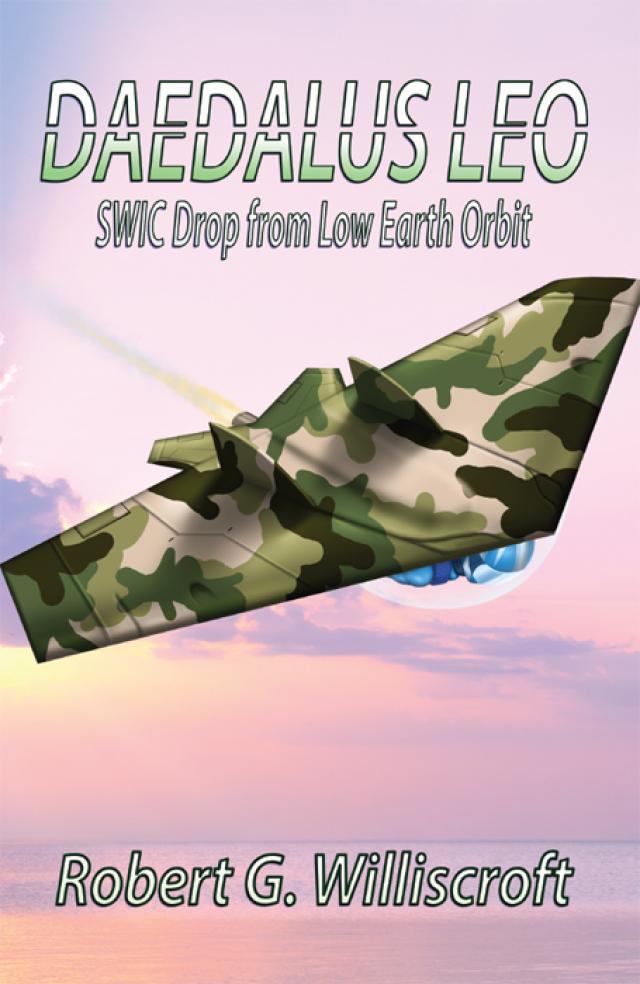
Robert Williscroft has done it again. The idea of jumping from orbit using little more than a spacesuit and a re-entry pack goes back at least to Heinlein’s Starship Troopers, and I’ve used it myself, but Williscroft puts a new twist on it as “Tiger” Baily makes the jump in Daedalus LEO. A great tale, with his usual attention to detail.
– Alastair Mayer
Author of The T-Space Series
Daedalus LEO by Robert G. Williscroft is even more exciting than Daedalus, the first story in this series. There are more thrills, more near-escapes, more humor, and more spectacular sightseeing of the Earth far below. More romance too, for that matter. This time around the author has upped the ante. It’s the first manned LEO (Low Earth Orbit) drop, and instead of 80 klicks, the Gryphon 10 has to drop 160, or twice as far. And of course, despite the best efforts of Derek “Tiger” Baily and his team, almost everything seems to go wrong.
Those who are the first to enter a new frontier incur a great risk. Numbers are not enough. Planning is not enough. Safeguards are not enough. As Derek says, “until we actually made the first drop, all we had were numbers that we hoped made sense.” You have to constantly be prepared for the unexpected, for times “when all hell breaks loose!” This is a great adventure, even better than the first, and I’m glad I was along for the ride.
– Professor John B. Rosenman, Norfolk State University
Former Chairman of the Board, Horror Writers Association
Author of The Inspector of the Cross Series
Daedalus LEO is about the unimaginable, yet somehow, Robert Williscroft not only imagined it but made it real—and breathtakingly thrilling.
The idea of a human being deliberately placing himself in low earth orbit to carry out a proof of concept mission is an image as fresh, and yet disturbing, as they come. Mind you, Derek “Tiger” Baily is an extraordinary human, and this is no ordinary story. Those of us growing up in the space age know full well that reentry from orbit is terrifyingly dangerous. The fires of reentry consume foolish mortals who make the slightest mistake. And mistakes and problems arise aplenty in Tiger’s trial run.
At risk is the future of American special warfare operations. Will Baily’s risky adventure be the birth of something entirely new, or yet another failed blue-sky concept ending in cinders?
– Dr. John R. Clarke
Author of The Jason Parker Series
Author Robert Williscroft delivers the goods once again with Daedalus LEO, a short sci-fi story that chronicles Lt. Commander Derek “Tiger” Baily’s flight from low-Earth orbit in a wingsuit. To call the Gryphon-10 a wingsuit is a stretch, but I think it conveys the idea without introducing spoilers. As with all of Williscroft’s work, the writing is tight and realistic. The characters are three-dimensional against a backdrop of excitement, thrills, and cliff-hangers. And the science in this sci-fi is damn accurate. In fact, much of the plot and details are science fact, and part of the fun, as with the work of the late great Michael Crichton, is trying to discern the thin line between truth and fiction. The Starchild Trilogy and Daedalus short stories are highly recommended to sci-fi/thriller aficionados. Five stars!
– Dr. Dave Edlund
USA Today Bestselling Author –
The Peter Savage Thrillers
DAEDALUS LEO
SWIC Drop from Low Earth Orbit
Copyright © 2019
by Robert G. Williscroft
All rights reserved
Fresh Ink Group
An Imprint of:
The Fresh Ink Group, LLC
Box 931
Guntersville, AL 35976
info@FreshlnkGroup.com
FreshInkGroup.com
Edition 1.0 2019
Cover art by Anik / FIG
Illustration by Anik / FIG
Book design by Amit Dey / FIG
Covers by Stephen Geez / FIG
Names, characters, and incidents in this story are either products of the author’s imagination or are used fictitiously. Any resemblance to actual events, locations, names, and people, living or dead, is entirely coincidental and beyond the intent of the author and publisher.
Except as permitted under the U.S. Copyright Act of 1976 and except for brief quotations in critical reviews or articles, no portion of this book’s content may be stored in any medium, transmitted in any form, used in whole or part, or sourced for derivative works such as videos, television, and motion pictures, without prior written permission from the publisher.
Cataloging-in-Publication Recommendations:
F1CO28020 FICTION / Science Fiction / Hard Science Fiction
FIC002000 FICTION / Action & Adventure
F1CO2801 0 FICTION / Science Fiction / Action & Adventure
Library of Congress Control Number: 2019911112
ISBN-13: 978-1-947867-59-8 Papercover
ISBN-13: 978-1-947867-60-4 Hardcover
ISBN-13: 978-1-947867-61-1 Ebooks
This story is dedicated to the U.S. Navy SEALS who may someday make this story a reality.
Acknowledgments
Foreword
Cast of Characters
Daedalus LEO
Low Earth Orbit
Coronado—San Diego—Several Days Earlier
Coronado—Gryphon
Coronado—Max
Slingshot—Equatorial Pacific
LEO—Unmanned Drop
Coronado—Manned Drop Prep
Howland & Baker Islands—Prelaunch
Amelia Earhart Skyport—Prelaunch
Amelia Earhart Skyport—Launch
Slingshot Rail - Coupled
LEO - Manned
LEO - Disaster
LEO - Rendevous
LEO - Miss
LEO—Orbit Shift
Figure 1—Orbital paths over US & Mexico
Figure 2—Orbital paths Kinshasa to Australia
Figure 3—Orbital paths over the Pacific
LEO—Manned Drop
Houston Flight Control—Landing
Daedalus LEO—Finale
Post a Review
Excerpt from the first chapter of Slingshot
About Robert G. Williscroft
Other books by Robert G. Williscroft
Connect with Robert G. Williscroft
Daedalus LEO Glossary
Several people contributed to the creation of this book.
Most significantly, my wonderful wife, Jill, whom I first met when I returned from a year at the South Pole conducting atmospheric research, and who finally consented to marry me nearly thirty years later, pored over this story with her discerning engineer’s eye. She kept my timeline honest and made sure that regular readers could understand fully the arcane details of the Launch Loop and the Gryphon.
Hard science fiction authors Alastair Mayer, John Clark, and Prof John Rosenman, and USA Today bestselling author Dave Edlund reviewed the manuscript and offered their editorial insights.
Lauren Smith from Fresh Ink Group applied her professional associate publisher’s eye to improve the story.
It goes without saying that any remaining omissions, errors, and mistakes fall directly on my shoulders.
Robert G. Williscroft, PhD
Centennial, Colorado
September 2019
Slingshot is my novel about constructing the world’s first Space Launch Loop. The book was launched August, 2015, at the International Space Elevator Conference in Seattle, and resides on the desk of every Space Elevator scientist in the world. Space Launch Loops appear in the subsequent books in The Starchild Trilogy, and anyone familiar with my Trilogy knows all about these commercial space launch systems.
When I discovered the Gryphon rigid wingsuit, the SWIC Daedalus Files pushed themselves into my consciousness. The first story is a consequence of Slingshot’s skyports effectively being eighty km tall wingsuit base-jumping towers. This second story follows naturally from the first.
SEAL derring-do is real, the science and technology are real, the Gryphon rigid wingsuit is real, and I suspect that something like SWIC will become part of the U.S. Navy SEALS in the relatively near future.
Robert G. Williscroft
Centennial, Colorado
September 2019
SEALS Winged Insertion Command (SWIC)
Capt. Brad Nelson—Commanding Officer SWIC.
Lt.Cdr. Tom Spitzer—Executive Officer SWIC.
Mother—Controlling computer in each Gryphon-10
Max—Full-size Gryphon-10 simulator
SEALS Winged Insertion Command Three (SWIC-3)
Lt.Cdr. Derek “Tiger” Baily—Narrator, Commanding Officer SWIC-3.
Lt. Jim Fox—Executive Officer SWIC-3.
Master Chief Jerry Boldt—Master Chief SWIC-3.
Senior Chief Bob Baxter—Master Chief Boldt’s second.
Launch Loop International (LLI)
Sam Davidson—Slingshot Director.
Apryl Searson—Chief Diver EMT.
Houston Flight Control
Disembodied voice—Houston Flight Control Director.
LOW EARTH ORBIT
“What the fuck!” I yelped as the rear of my Gryphon-10 pallet tilted sharply upward while the nose yawed to the right. Then the whole thing started to tumble in a spiral fashion as the kick thruster continued its burn. Mother wasn’t stopping it, so I activated the manual jettison override. I watched the burning kick thruster spiral ahead of me and then flare out. I lost it in the glare of the morning sun.
“I got a problem here, Control,” I said as calm ly as I could manage. I described what had happened from my limited perspective. “Mother, deploy the tethered holocam and make a full external inspection,” I ordered as I began to get my act together.
“Tiger, we are calculating your modified orbital parameters right now,” Master Chief Boldt told me with his calming voice. “Okay…here it is. You are nominally still at one-hundred-sixty klicks, but your orbit has shifted right by twenty-two-point-five-degrees. That passes over central Mexico, well south of Baja. You’re stable, but you have to get control of your tumble so we can calculate a new set of drop parameters.”
“Roger,” I said.
“Tethered holocam deployed,” Mother said softly.
Mother controlled the bird-size tethered holocam to ensure that it maintained a stable position relative to my corkscrew. Using additional short gas bursts, I maneuvered the holocam down the length of the pallet and Gryphon-10 looking for damage.
“Jesus H…,” I muttered as it moved to my stern. “Are you getting this, Control?”
“Roger, we are.”
The back end of the pallet was partially melted, and a large chunk was missing from my right fin.
“Mother, can I survive reentry with that fin damage?”
“Negative, Tiger,” Mother said softly, “Probability of complete structure failure one hundred percent.”
CORONADO—SAN DIEGO—SEVERAL DAYS EARLIER
Derek “Tiger” Baily—you may remember me. The Gryphon-7? My 80,000-meter base jump from the Fred Noonan Skyport on Slingshot? Well…so much for fifteen minutes of fame, but you still can see Gryphon-7 at the Smithsonian, and you can read about my exploit if you dig a little bit.
I’m still with the Teams—the U.S. Navy SEALS, but now I command SEALS Winged Insertion Command Three, SWIC-3 for short. I suspect somebody in the hierarchy goofed after I completed that 80,000-meter base jump, but I got orders to OCS—that’s Officer Candidate School for you non-military types—and ended up back at SWIC-3 as a freshly minted Butter Bar—Ensign. We continued our Gryphon development with me as XO under Lt.Cdr. Tom Spitzer. Senior Chief Jerry Boldt was still with us, in line for Master Chief. By the time my old CO Brad Nelson made Captain, they gave him command of SWIC, assigned Tom as his XO, and I got command of SWIC-3 along with early promotion to Lt.Cdr. Like I said, somebody really goofed up there, but who am I to argue with them? Besides, they sent me Lt. Jim Fox as XO. He had come up through the SEAL ranks like me, and I couldn’t have gotten a better man to back me up.
My assignment, SWIC-3’s assignment, was probably impossible to accomplish. I figured that just made it interesting. All Capt. Nelson wanted was for SWIC-3 to do a Gryphon drop from LEO—Low Earth Orbit.
CORONADO—GRYPHON-10
Gryphon-7 had been relegated to the annals of SEAL history. Gryphon-8 incorporated the structural changes resulting from my water landing, causing the craft to act more like a surfboard when upside down in the water, and giving it external propulsion—basically incorporating a water-jet. Gryphon-9 changed a lot of things. It had larger wings with more fuel capacity, more powerful jet with throttle control, longer tail, and more intuitive control interface.
Gryphon-10 is the baby we would use for the LEO drop. It had some radical changes including full body armor with circulating fuel for heat protection, an increased surface area using dimples, wrinkles, and rolls that dramatically boosted heat shedding, and it incorporated a new type of polymer that was stronger, lighter, and more heat resistant than anything before. The biggest change, however, was the guidance computer unit—we called it Mother—that was designed to act on its calculations before the human pilot was even aware of them. Gryphon-10 was still man-transportable, although more ungainly than the old Gryphon-7 model. Its unpowered glide ratio was 14-1, and it could fly 100 level klicks under power.
Unlike Gryphon-7 that started at eighty klicks with zero velocity, Gryphon-10 would start at 160 klicks moving at orbital velocity. To survive the jump, Gryphon-10 had to shed as much velocity as possible as quickly as possible. We needed to get from Mach 26 down to about Mach 3. What we’d do was to dip down into the atmosphere shedding speed until drag brought the temperature to the limit, and then skip back out of the atmosphere to let the suit cool off. Then back in again, shed more speed, heat to the limit, and back out to cool off. And again…and again…using a bit of fuel for each dip until we slowed to about Mach 3. Then dip for the last time, and stretch out the glide for max distance—and land at the desired destination. We ran the problem in reverse, letting the computers work out the number and details of the skips in order to specify where in our equatorial orbit we would need to commence the drop. We threw every variable we could think of at the problem and calculated the drop for 10,000 different scenarios.
CORONADO—MAX
To help plan the drop, we constructed Max—a full-scale simulator that cost a good deal more than the actual Gryphon-10. Everyone in SWIC-3 ran Max dozens of times. I did the first run and crashed and burned big time. With practice, we got the system down and a feel for what to do during each skip into the atmosphere.
Now, here’s the rub. Everything we did up to this point was theoretical—even with Max. We gave Max every scrap of reentry information we could find, everything we knew about upper atmosphere weather, every bit of physics that could possibly bear on the problem. Mother knew everything Max knew and was connected to worldwide live feeds. In a real drop, Mother would know everything possible about the path ahead, and everything Max had done in similar situations during simulation runs. Mother would have every possible edge to give us the desired outcome. Yet…until we actually made the first drop, all we had were numbers that we hoped made sense.
SLINGSHOT—EQUATORIAL PACIFIC
Beyond Max, we ran real jumps using the full Gryphon-10 from Fred Noonan Skyport on Slingshot to Kiritimati and even to Tabuaeran Atoll about 100 klicks further north. We didn’t challenge a squall like I had done on the first Kiritimati jump, but I was confident that the Gryphon-10 could have handled it with ease. We did soft belly landings, near-shore water landings, and blue-water landings. We had no problems—none at all.
That was encouraging, to say the least.
LEO—UNMANNED DROP
I sent Master Chief Boldt to Baker Island with four SWIC-3 members. They lifted to Amelia Earhart Skyport with the empty Gryphon-10 attached to a cargo pallet. After ensuring that everything was fully ready for the drop, they launched the pallet with its load.
The process of obtaining a circular orbit was automatic until the actual launch of Griffon-10. I controlled that from our Flight Control Center (FCC) at Coronado.
I initiated the drop sequence and then sat at the Command Console, watching Mother do her thing. We shed velocity with three dips, and a few minutes later, Gryphon-10 was circling about two klicks above San Diego Bay shedding the last of her forward velocity and altitude.
Ten minutes later everyone but me pushed through the FCC door as Gryphon-10 spiraled to a picture-perfect landing ten meters from the door.
CORONADO—MANNED DROP PREP
Every SWIC-3 member wanted to do the first manned LEO drop—including me. They chose me to do the first static drop from Slingshot back in my enlisted days because I was easily the most experienced wingsuit man in the Teams—that’s why they recruited me in the first place. But now, I was part of they. I still was the most experienced wingsuit man in the Teams, more so now than ever. Furthermore, I had more experience in Gryphon-10, both in Max and for real drops, than anyone else—close to as much as everyone else combined. Not only did I have more Max drops under my belt, but I also had more Max disasters, and I had found creative ways to extricate myself from several of them. But I also was CO of SWIC-3. Despite what you see in holobroadcasts, commanding officers do not normally do everything personally. They surround themselves with good people, and then they assign the best people to the task at hand.
I know that Capt. Nelson had several high-level discussions with his Team boss, and I suspect the discussions went even higher. What we were attempting was still classified above Top Secret, but our success would give a dramatic new insertion capability to the generals and admirals who make the big plans. I’m sure the interest went all the way to the White House.
In the end, I was ordered to the assignment, Lt. Jim Fox was given temporary command of SWIC-3, and Master Chief Jerry Boldt was temporarily assigned as Executive Officer. Senior Chief Bob Baxter took over for Master Chief Boldt, and the Team members supplied their best efforts in support.






