

Daedalus squad, p.1
Daedalus Squad, page 1


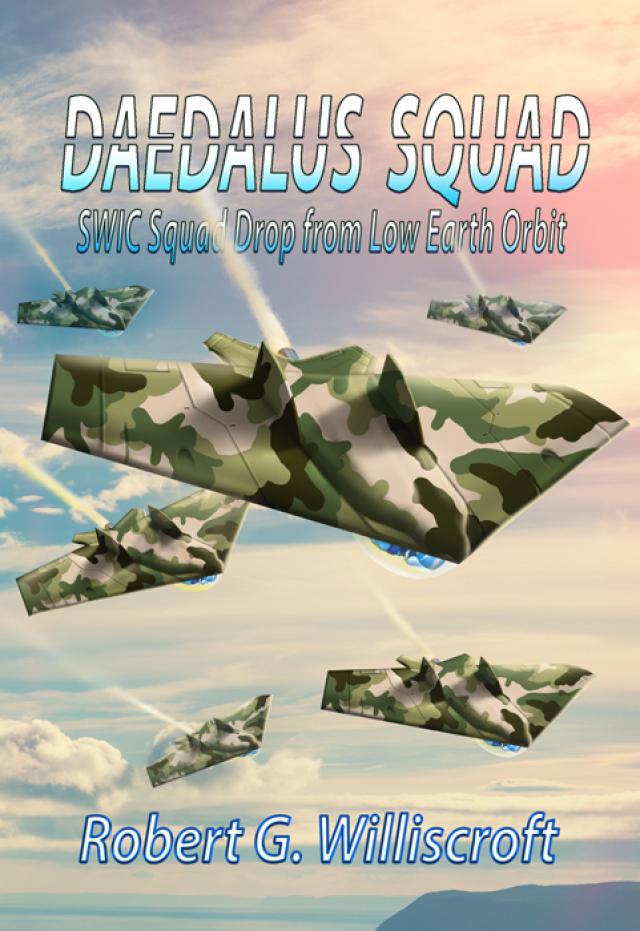
Robert G. Williscroft’s Daedalus Squad brilliantly advances the missions that readers encountered in the first two stories of the Daedalus Files. This time, a six-man squad in improved wingsuits launches into Low Earth Orbit and travels around the globe before landing. Its purpose is to do it eventually under combat conditions. As you might expect, something is bound to go wrong with this training mission, and it does, leading to a tense conclusion.
The near-future scientific and technological detail here is thoroughly convincing. The space hardware involved, especially the improved Gryphon-10 Mk 4 wingsuit might actually come off the assembly line in a few years, awaiting its first occupant. As in the author’s previous stories, maps show the global paths of the men and make it easy to follow their progress in space. At times, you even feel you’re along for the ride.
— Professor John B. Rosenman,
Norfolk State University Former Chairman of the Board, Horror Writers Association Author of The Inspector of the Cross Series
More space-going SEAL action from Robert Williscroft. “Tiger” Baily, the wingsuited, space-jumping hero of Williscroft’s Daedalus Files, has the stakes upped once again as his whole team makes a jump from orbit in Daedalus Squad. This time they’re leaving nothing to chance and have already simulated every possible bad-news scenario they can think of. Too bad nature can come up with something they didn’t think of. Another fun ride, if your idea of fun includes death-defying action.
— Alastair Mayer
Author of The T-Space Series
Daedalus Squad is the latest in a series of tales by Robert G. Williscroft, centered around an experimental Navy SEAL team, the SEALS Winged Insertion Command (SWIC), exploiting a futuristic space launch system to reach Low Earth Orbit—without a rocket.
That technology was well explained in Williscroft’s previous novel, Slingshot. The SWIC Daedalus Files concern the development of special combat operations with easy access to space.
As with most experimental research, in Williscroft’s stories, there are challenges—and mishaps galore. In this storyline, with humans hurtling around the Earth at orbital velocities, there is precious little room for error. Controlled re-entry of a human body is even riskier. All of that riskiness translates into an exciting read.
Aside from the thrills inherent in such feats of heroism, this story is educational. If you’ve wondered how orbiting spacecraft maneuver to change orbits, or rendezvous with other orbiting bodies (in this story, literally human bodies), Daedalus Squad will reveal enough of the lingo to help you search online and find out how it’s done.
That education alone adds an unexpected dimension to this treasure of a story. You will definitely want to read this one and the next offering in the SWIC Daedalus Files.
— Dr. John R. Clarke
Author of The Jason Parker Series
This short story by author Robert Williscroft continues the adventures of Lt.Cdr. Derek “Tiger” Baily. Sporting the newest version of the wingsuit (the Gryphon 10 Mk 4), Tiger plans to link up with the other members of his squad in Low Earth Orbit and then descend in formation to a landing at the Amargosa Valley. When the plan goes awry, Tiger must think quickly and use his considerable flying skills to avoid certain death.
The Daedalus adventures, each a short story, follow Slingshot, delivering exciting and thought-provoking sci-fi entertainment through the voice of Tiger. Each adventure stands alone, but I’d recommend reading them in order to appreciate how the characters develop.
— Dr. Dave Edlund
USA Today Bestselling Author The Peter Savage Thrillers
Daedalus Squad:
SWIC Squad Drop from Low Earth Orbit
Copyright © 2019
by Robert G. Williscroft
All rights reserved
Fresh Ink Group
An Imprint of:
The Fresh Ink Group, LLC
1021 Blount Avenue, #931
Guntersville, AL 35976
Email: info@FreshInkGroup.com
FreshInkGroup.com
Edition 1.0 2019
Images by Robert G. Williscroft
Book design by Amit Dey / FIG
Artwork by Anik / FIG
Cover design by Stephen Geez / FIG
Associate publisher Lauren A. Smith / FIG
Except as permitted under the U.S. Copyright Act of 1976 and except for brief quotations in critical reviews or articles, no portion of this book’s content may be stored in any medium, transmitted in any form, used in whole or part, or sourced for derivative works such as videos, television, and motion pictures, without prior written permission from the publisher.
Daedalus Squad is a work of fiction. It contains real science and engineering, but the author makes no claims for the authenticity or accuracy of these elements. Any reference to individuals, governments, corporations, or entities is purely the result of the author’s imagination. Any resemblance to actual persons, living or dead, or governments, corporations, or entities, past or present, is entirely coincidental.
Keywords: Amelia Earhart Skyport, Australia, Baker Island, Coronado, Fred Noonan Skyport, Free Fall, Gryphon, Hawaii, Howland Island, Hypergolic, Jarvis Island, Keith Lofstrom, Launch Loop, Lagos, Madagascar, Orbit, San Diego, SEALS, Spacesuit, SWIC, Wingsuit
Cataloging-in-Publication Recommendations:
FIC028020 FICTION / Science Fiction / Hard Science Fiction
FIC002000 FICTION / Action & Adventure
FIC028010 FICTION / Science Fiction / Action & Adventure
Library of Congress Control Number: 2019914485
ISBN-13: 978-1-947867-62-8 Papercover
ISBN-13: 978-1-947867-63-5 Hardcover
ISBN-13: 978-1-947867-64-2 Ebooks
This story is dedicated to the U.S. Navy SEALS who may already be working on a concept like the Gryphon.
Dedication
Acknowledgments
Foreword
Cast of Characters
Daedalus Squad
8,000 Meters Above Death Valley
Coronado—San Diego—Several Days Earlier
Coronado—Gryphon-10 Mk 4
Coronado—Max
Coronado—Squad Drop Prep
Howland & Baker Islands—Prelaunch
Amelia Earhart Skyport—Prelaunch
Amelia Earhart Skyport—Launch
Slingshot Rail
LEO
LEO—Squad Drop
Death Valley—Bird Strike
Death Valley—Snag
Daedalus Squad—Finale
Please Post a Review for Daedalus Squad
Excerpt from the first chapter of Slingshot
Words of Praise for Slingshot
About Robert G. Williscroft
Other books by Robert G. Williscroft
Connect with Robert G. Williscroft
Daedalus Squad Glossary
Several people contributed to the creation of this series.
Most significantly, my wonderful wife, Jill, whom I first met when I returned from a year at the South Pole conducting atmospheric research, and who finally consented to marry me nearly thirty years later, pored over this story with her discerning engineer’s eye. She kept my timeline honest and made sure that regular readers could understand fully the arcane details of the Launch Loop and the Gryphon.
Hard science fiction authors Alastair Mayer, John Clark, and Prof John Rosenman, and USA Today bestselling author Dave Edlund reviewed the manuscript and offered their editorial insights.
Lauren Smith from Fresh Ink Group applied her professional associate publisher’s eye to improve the story.
It goes without saying that any remaining omissions, errors, and mistakes fall directly on my shoulders.
Robert G. Williscroft, PhD
Centennial, Colorado
October 2019
Slingshot is my novel about constructing the world’s first Space Launch Loop. The book was launched August, 2015, at the International Space Elevator Conference in Seattle, and resides on the desk of every Space Elevator scientist in the world. Space Launch Loops appear in the subsequent books in The Starchild Trilogy, and anyone familiar with my Trilogy knows all about these commercial space launch systems.
When I discovered the Gryphon rigid wingsuit, the Daedalus stories pushed themselves into my consciousness. The first story is a consequence of Slingshot’s skyports effectively being 80 km tall wingsuit base-jumping towers. The second story, Daedalus LEO, follows naturally from the first—a drop from Low Earth Orbit (LEO). This story is a consequence of the proof-of-concept LEO drop. In this story, an entire SWIC squad drops from LEO together, in preparation for the final tale, an actual combat drop.
SEAL derring-do is real, the science and technology are real, the Gryphon rigid wingsuit is real, and I suspect that something like SWIC will become part of the U.S. Navy SEALS in the relatively near future.
Robert G. Williscroft
Centennial, Colorado
October 2019
SEALS Winged Insertion Command (SWIC)
Navy Capt. Brad Nelson—Commanding Officer SWIC.
Lt.Cdr. Tom Spitzer—Executive Officer SWIC.
Mother—Controlling computer in each Gryphon-10
Max—Full-size Gryphon-10 simulator
SEALS Winged Insertion Command Three (SWIC-3)
Lt.Cdr. Derek “Tiger” Baily—Narrator, Commanding Officer SWIC-3.
Lt. Jim Fox—Executive Officer SWIC-3.
Master Chief Jerry Boldt—Master Chief SWIC-3.
&
1st Squad—SWIC-3
Lt. Roger “Rog” Brook—Squad Leader
Chief Douglas Slade
Petty Officer 1st Class Francisco “Jerico” Rodriguez
Petty Officer 1st Class Ronald “Cappy” Caplan
Petty Officer 2nd Class Peter “Pete” Farwall
Not participating in the drop
Petty Officer 2nd Class Benjamin “Benny” Williams
Petty Officer 2nd Class Christopher “Piggy” Pigwell
Petty Officer 3rd Class Clyde “Cowboy” Horseman
Launch Loop International (LLI)
Sam Davidson—Slingshot Director.
Apryl Searson—Chief Diver EMT.
C-130 Hercules
Lt.Col. Randal Dorsey—C-130 Hercules pilot
8,000 METERS ABOVE DEATH VALLEY
“What the fuck was that?” someone yelled. It sounded like Jerico Rodriguez—a bit of Hispanic twang. Then I heard a loud crunch as my heads-up display went crazy.
“Shit!” I yelped as my hardshell wingsuit commenced rolling hard to the right. Mother automatically torqued my wings to compensate but without much success. I activated my hypergolic rocket, but nothing happened.
I cleared the alarms in my heads-up display and moved them to the right corner. I could see my squad in formation behind me as I lost altitude on a rolling plunge from 8,000 meters. Chief Douglas Slade’s blip moved above my position.
“You got a hole the size of Cappy’s head in your right wing,” he said, referring to Petty Officer First Class Ronald Caplan. “You ain’t got no UDMH left.”
“Tell me about it,” I muttered.
“I got a problem here, Control,” I said, trying to keep my voice steady. I briefly described my situation. “I need some immediate help to get out of this.”
CORONADO—SAN DIEGO—SEVERAL DAYS EARLIER
Derek “Tiger” Baily again. I suspect you remember my base jump from Fred Noonan Skyport and my LEO drop or you wouldn’t be reading this. Have you seen Gryphon-7 and Gryphon-10 hanging in the Smithsonian Atrium? They’re a bit worse for wear but pretty cool to look at.
I’m still with the Teams—the U.S. Navy SEALS, and continue to command SEALS Winged Insertion Command Three, SWIC-3 for short. The way things are in the military right now, I’m probably stuck with my present rank, Lieutenant-Commander.
We were about to do a proof-of-concept LEO drop with an abbreviated 6-man squad using Gryphon-10 Mk 4s. I took the lead on this one, pushing my 1st Squad Leader, Lt. Roger Brook, down into the ranks displacing Petty Officer Clyde Horseman, much to Cowboy’s displeasure. Cowboy, as everybody called him, along with Petty Officers Benjamin Williams and Christopher Pigwell—Benny and Piggy to the squad, were on standby in case something went wrong.
CORONADO—GRYPHON-10, MK 4
Gryphon-10 Mk 4 looked exactly like the wingsuit I used for the first LEO drop. It differed in subtle ways, however, because of improvements we developed as I and each of my guys made several LEO drops gaining experience and proficiency along the way.
Beyond that, since we intended to use the Gryphon in combat, we incorporated the latest model of a very efficient, hand-held, pulsed energy weapon into a node in the leading edge of either the left or right wing. Its power source is a lightweight BatCap, a unique marriage of a 3-D battery and a thin, large-surface-area flexible capacitor that the SWIC member wears on his back. The capacitor supports twenty rapid-release lethal laser bursts and recharges in less than a minute from the 3-D battery, or it can continuously support a lethal laser burst every five seconds. The 3-D battery needs recharging every five thousand bursts. Before opening the carapace after landing, the SWIC member retrieves the weapon from its node and holsters it just like a sidearm.
Launch pallet improvements ensured that nobody had to go through what happened to me on my first LEO drop. Each pallet carried four tanks. Two were HP oxygen used by the flyer until Gryphon separation, attached to the wingsuit with breakaway connectors. The other two carried hypergolic fuel, UDMH and nitrogen tetroxide, for the small hypergolic maneuvering jets that would allow us to get into formation and maintain our pattern until we dropped. Each SWIC-3 team member had completed five LEO drops. Every one of us reached a level of confidence and proficiency as we dealt with problems and solved them on the fly, so to speak. We were as ready as possible for the next step, making a coordinated drop from LEO and landing together at a designated spot on the planet in preparation for doing it for real under combat conditions.
That is, of course, if things went according to plan.
What we were attempting, at least in principle, was straightforward. The six of us would launch in sequence from Amelia Earhart Skyport. Mother would coordinate our detaching from the rail into Hohmann Transfer Orbits (HTO) so that we would find ourselves in a tight group when we reached LEO. From there, at the proper time, we would drop together, again coordinated by Mother, finally landing at our destination, ready to discard our wingsuits to carry out our assigned ground mission or, for that matter, to carry them with us on our backs.
CORONADO—MAX
Max, our full-scale simulator, played a significant role in our preparation. We didn’t have the budget for six Max simulators, so we set Max up to simulate a drop of six Gryphon-10s with one person at a time in the driver’s seat. Each of us ran the Max squad-simulation dozens of times. I did the first run and actually landed the entire squad without a problem. I guess Max was being easy on me because I crashed and burned big-time on my second run. With practice, we all became so proficient that in the end, Max was not able to crash any of us. Remember, however, that Max was only as good as his programming. We entered virtually every kind of possible contingency we could think of, and Max threw every one of them at each of us, singly and in various combinations. Too bad we were not a bit more imaginative thinking up possible things that could go wrong.
Just like on my first LEO drop, however, everything we did up to this point was theoretical, everything. As before we not only gave Max every scrap of reentry information we could find, but Max also had everything we had generated with our many LEO drops since then. Max already had everything we knew about upper atmosphere weather and every bit of physics that could possibly bear on the problem. Mother knew everything Max knew and was connected to worldwide live feeds. In our real drop, Mother would know everything possible about the path ahead, and everything Max had done in similar situations during simulation runs. Mother would have every possible edge to give us the desired outcome. Yet…until we actually made the first squad drop, all we had were numbers that we hoped made sense.
CORONADO—SQUAD DROP PREP
We had reached a level of experience and proficiency so that we no longer set up a backup unit for each of our drops. As always, each man was ultimately responsible for his own Gryphon. Before we loaded the six units on the waiting Navy jet transport, Master Chief Boldt and I inspected each unit, carefully and completely. Then each team member inspected his own unit again. This was the big one—failure was not an option.
Capt. Nelson maintained his high-level discussions with his Team boss. On this morning, Capt. Nelson informed me that the White House would be watching on an encrypted holobroadcast. Apparently, the Commander-in-Chief was a frustrated wingsuit flyer wannabe.
HOWLAND & BAKER ISLANDS—PRELAUNCH
I departed Coronado for North Island Airfield with Senior Chief Baxter and the entire First Squad plus three guys from Second Squad. I wanted one man assisting each flyer with the Senior Chief in charge. We were pretty busy, and I don’t remember saying anything witty as I had done on our departure for the first LEO drop. I do recall thinking that this would be a piece of cake. Good thing I didn’t say that out loud, as it turned out.
Trips to Howland Island on the Navy supersonic transport were becoming pretty routine. This one was no different. We jetted down the runway, lifted through sparse clouds into a brilliant blue stratosphere, leaving a layer of puffy cirrocumulus clouds far below us. We turned toward Hawaii as we accelerated to nearly Mach 2.
I slept right through our refueling stop in Hawaii, waking up as we rolled to a stop at Amelia Earhart International Airport under a blistering equatorial sun. As if they were greeting my return, thousands of sooty terns, lesser frigatebirds, and masked boobies filled the sky, kept clear of aircraft by built-in sonic systems.






