

Carrion, p.1
Carrion, page 1


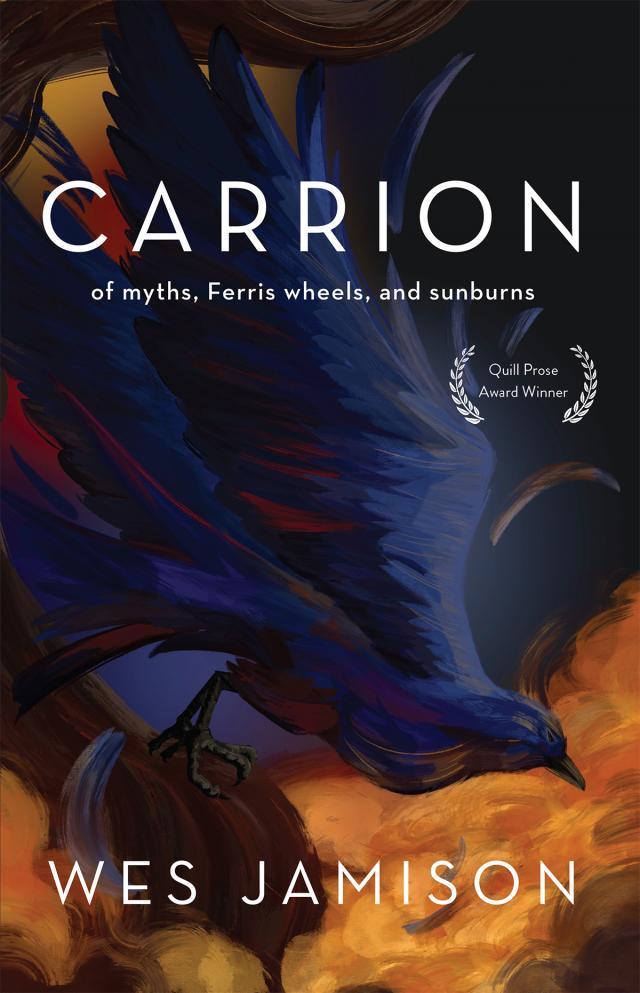
Carrion
Copyright © 2024 by Wes Jamison
All Rights Reserved
No part of this book may be used or reproduced in any manner whatsoever without the prior written permission of both the publisher and the copyright owner.
Book layout by Mark E. Cull
Library of Congress Cataloging-in-Publication Data
Names: Jamison, Wes, author.
Title: Carrion: essays / Wes Jamison.
Other titles: Carrion (Compilation)
Description: First edition. | Pasadena, CA: Red Hen Press, 2024.
Identifiers: LCCN 2023041912 (print) | LCCN 2023041913 (ebook) | ISBN 9781636281162 (paperback) | ISBN 9781636281179 (ebook)
Subjects: LCGFT: Essays.
Classification: LCC PS3610.A49 C37 2024 (print) | LCC PS3610.A49 (ebook) | DDC 814/.6—dc23/eng/20231103
LC record available at https://lccn.loc.gov/2023041912
LC ebook record available at https://lccn.loc.gov/2023041913
The National Endowment for the Arts, the Los Angeles County Arts Commission, the Ahmanson Foundation, the Dwight Stuart Youth Fund, the Max Factor Family Foundation, the Pasadena Tournament of Roses Foundation, the Pasadena Arts & Culture Commission and the City of Pasadena Cultural Affairs Division, the City of Los Angeles Department of Cultural Affairs, the Audrey & Sydney Irmas Charitable Foundation, the Meta & George Rosenberg Foundation, the Albert and Elaine Borchard Foundation, the Adams Family Foundation, the Riordan Foundation, Amazon Literary Partnership, the Sam Francis Foundation, and the Mara W. Breech Foundation partially support Red Hen Press.
First Edition
Published by Red Hen Press
www.redhen.org
Acknowledgments
I’d like to thank the editors and readers of the following publications, in which individual essays appeared (sometimes in (very) different versions):
Cahoodaloodaling Magazine: “No-One Suspects Your Shoulderblades of Wings”; Fifth Wednesday Journal: “How Not to Drown”; Gigantic Sequins: “Mother”; Gone Lawn: “Eve”; and Wilde Magazine: “Carrion.”
I’d also like to thank my MFA cohort, Sharon Ryan Burns, Ali Carpenter, Micah McCrary, Toni Nealie, Colleen O’Connor, Ryan Spooner, Jenn Tatum, and Tatiana Uhoch, who saw countless of these essays and their revisions long before this even became a project. Thank you for seeing this as and for shaping this into a project, for your support and your trust. Thank you, too, to the professors who taught me not only how to write but also the essay as a practice: Aviya Kushner, Shannon Lakanen, David Lazar, and, most importantly, Jenny Boully, who formally advised this as a thesis, who encouraged me and reminded me to “trust [my] writerly instincts.” And, of course, thanks to Red Hen Press, T.S. Eliot, and Virginia Woolf. Thank you, my family, for seeing me, even when the camera did not.
Contents
Carrion
Toxicity
Periphery
Carrion
To Build a Ferris Wheel
I thought it would happen as in a myth.
Coronis
Carrion
Mother
Mother
Conflagration
How Not to Drown
Carrion
Carrion
Carrion
No-One Suspects Your Shoulder Blades of Wings
Eve
Notes
Let me then create you. (You have done as much for me.)
—Virginia Woolf
Carrion
I have been lying about the ravens since the beginning. I have said I see them all around me and that they follow me; but I do not, and they do not. In truth, two nights in a row, I noticed three or four of them perched outside my window. I took two reddened-night photos, intending to track them, to see if they remain in or return to the same position, posturing, location. I never compared them, and they never returned, but they remain indexed in the photos and by the white excrement covering the lower branches of that tree.
I am lying still. There are no ravens in the Midwest. What I see, what we see when we see large black birds that are not blackbirds or starlings are crows. I call them ravens, because I do not like the word crow; because I would prefer them to be ravens, to be literal, actual, real ravens. But they just aren’t, no matter how much I wish or weep.
I do not see ravens—and we must simply accept that the name I give them and the entities themselves are not consubstantial, that words deform reality, no matter the word I use, that calling a thing a thing does not make it a thing at all but merely a thing that I call a thing that you may call anything else—I do not see ravens all around me, no, but I have noticed one atop what seems to be a lightning rod jutting from the Germanesque turret on the building almost catty-corner from mine, though the lack of significant height probably would indicate that it is, in fact, a weather vane. Regardless. I have noticed one in the large grassy lot I walk past on my way from the train. Once, I noticed one near the park next to my apartment carrying a Ziploc bag of Cheez-Its.
When I come upon them, my reaction is severe. Maybe three years ago, I stumbled upon one perched on a handrail: it was larger than any other I had seen, it didn’t move, and it was so close that I could distinguish, for the first time, individual oily feathers—see through them to the calamus, the quill. It was prehistoric, aged in a way that pulls gums from teeth, cold in a way that tightens flesh around a hair follicle, distressed and malnourished in the way we all eventually become ribbed and essential. The implied violence, its proximity, its lack of perceivable alarm at my closeness immediately frightened me, frozen by the fact that I could have reached out and touched it.
The quills seemed pungent and so uncannily similar to the roots of teeth: I was twenty-one and had just experienced my first wisdom teeth pains. I had recently extracted from an X-ray that, despite developing for those twenty-one years, the roots of my teeth were not yet complete, still open at the ends. As they broke the gums, I could smell them, like rot, not because they were rotten but because they were newly exposed, just as I expect our viscera do, never before having witnessed all this nitrogen, oxygen, argon.
The pain forced itself along my entire jaw and ear and gums and tongue and eye, a sign, I was sure, that these could not comfortably coexist with the others. They need to be removed. (I have yet to undergo this procedure.) I don’t want to. They are mine and always have been. Despite how common wisdom teeth removal is and despite how we all lose our first set of teeth, we are each born with these, our teeth, and to remove them—to rip or cut or break them out instead of letting our bodies naturally reject that which is no longer useful—is to no longer be our original, whole, complete selves. I have known my adult teeth longer than I have not known them: the first were so short-lived, growing in before memory began and falling out before I could grow attached. But I know these teeth. This is the version of my body I know.
You are your teeth, as I am mine, in part, and we use not only our hands and feet but also our legs, our abdomen, our back, lungs, heart, brain, keratin, our carbon, our teeth to—whatever it is used for, the body is a tool. Newly missing teeth, our bodies are fragmented; the tool, perhaps, broken.
One interpretation would be that that raven forced an irruption of the Real (this is Lacan): the horror of it, the sudden realization that I am in need (constantly needing). Food, shelter, water, interpersonal contact, medication, transportation, hobby, occupation, money, limbs and digits, iron, to expel waste. We need these things—these things that are so apparent to others in our neonatal state—so that we may not die. Our entire existence, it seems, is based on needing not to die and to produce descendants; and children and animals, they are the ones whose lives of need are not censored.
But we cannot consciously live as they do: we cannot afford or are literally unable to tell each other, without that artifice of language, I need to live. When I write I need to live, I am just using the words to designate that which we designate as coming closest to the desired meaning, but that meaning is not the actual. Language cannot capture the semiotic, a mating call or the cry of an infant. Words are unable to capture, no matter how well-tempered they may be, the look of my grandfather’s eyes when we found them still open and the oxygen machine still running and Animal Planet still playing when we found him dead. There is no eighty-one-year-old body with twenty minutes of decomposition already set in there.
I need to live.
All ravens have become symbol. I have found in all ravens that which I found in that first: I am growing, I am aging, I am dying, will die. And this growth, this progress, is painful. I will leave here neither whole nor unscathed. That pain—the pain I had to simply suffer through for weeks, that I could in no way curb or suppress, through which I simply had to cry, like this, and that fear, the fear of being attacked, of confronting something prehistoric and base: proof that we are mortal; our bodies, transient.
(This project is tricky, because I am circling the waters of the prelapsarian. But perhaps that’s why I continue to write about these birds—only for the simple fact that I can’t get it right, I haven’t, and I won’t. I will forever be postlapsarian, fallen, exiled from Eden, always cursed by the burden of language and its distortion.)
Words distort reality, and language is merely a fragile, so-breakable sheen over the body, bodies, the concept of the body. To say I am dying or I feel like dying or I will die—it means nothing. But the body can certainly feel or know or, in a way, trust that it will become inanimate, decompose, become something else to be used by something else. The body knows things w
The ejaculate stayed in me long enough for it to seep. My body created and then failed to close a bleeding open wound, accepting some number of viruses greater than twenty-five. They were attracted to it like a shark, and they couldn’t all be killed by my defenses quickly enough.
I no longer dread, because it has already entered my blood and replicated itself through my white blood cells, ripping them from the inside out, leaving only these sheaths of procreation. I will certainly outlive any complications, but I grew up in a time when the most horrible thing about Matthew Shepard’s death was that the officer who found him was exposed to HIV, a time when we were still being taught that just the diagnosis is a death sentence. That when that officer tested negative it was a relief. Regardless. No matter how much has changed since then, without medication, the body crumples in on itself from its lack of viable immune system.
Illness, chronic illness seems to be the only way to confront, accept, trust in our bodies’ fleetingness. Only when we see our blood leave us in seven purple vials—and only when those are moved from our elbows to our own palms, holding our own heat. It seems to me that we can only know mortality if we are violently thrust into it, or if it is thrust into us.
And when our lungs or liver or knuckles or scapula or nerve endings or sphincter are not suffering, or we do not know that we are, the ravens return to remind us.
My response to each and every raven proves they are more to me than just their bodies. Perhaps if I were ever in the mood to track and report on the purely physical, I would never have begun writing about them. But they are large and metaphysical, outside of temporality, inhabiting more than their own bodies.
I try to write the raven, the symbol and the body of the raven, but I cannot, because I have lapsed into language, and words only wrap themselves around and function as index to the actual. But to get to the truth, we have to confront the fear, our fears. Confrontation becomes easier when we deal with a physical manifestation or representation of something metaphysical. So I do not make much attempt at discovering what happens in a rotting body, a twenty-minute-dead body, but instead attempt to discover that which makes a raven not a crow and makes a raven fly and why a raven circles in flight and just how smart they are.
I write about ravens repeatedly, knowing that I cannot in this way come any closer to them. I never do: I never get any closer to approximating their bodies or that which they represent. Language is futile, because it is the body, not the language we use to describe a body, that holds meaning. But the attempts are not without meaning: I begin to circuit them, circle through currents of hot air, waiting to get high enough before I proceed, only to fall, then circle and rise again.
I want to outline them, provide silhouette, draw their perimeters, their limits; I want to wrap words around their mitochondria, their throat and crop, their crown, their mantle and flank, their secondaries and tertials, ribs and trachea, around their anterior-facing digits if no words may actually fill their void on this page. This is as close as I can come: if I may not write them, I’d like to imply them in this way.
Each time I circle, each time I prod at the corpse of a raven, I feel like I have found the heart of the matter, arrived at the center. To get past the first sentence, to leave that first sentence intact, we must trust that, if we are not there, at the center, we are at least one sentence closer. Of course, if the goal of writing is to confront that which frightens us, if we got there (where) in one sentence, we would be too scared to continue—always unable to say what it really was that we wanted.
Any word we write past the first admits that we are not yet there, though we are trying. If we could say it, could provide truths easily, clearly, we wouldn’t need second, third, eighteenth sentences. We would not need books. (I would not need this book.) Art is predicated on the impossibility.
So, if we genuinely fear, we attempt and attempt again.
I write that they are following me, that I am special to them; but they are not, and I am not. Instead, after I write this, I convince myself of it, because I feel as though I have come as close as I can to the truth. These truths, preemptive.
I wanted them to think I am special. I wanted them to need me, to literally fall out of the sky without me. I wanted to be the object of their affection, their only and biggest carrion, their sun. But I am not. Not theirs. Even if they were temporarily mine, if I happen to be the one to notice their presence, I would merely be a short-term gallows-keeper, yet another hanged man to them. But I would be replaced. Yes, we all want to be the object of affection, but affection, desire, is discretionless, merely seeking placeholders. This is how desire functions: we do not desire X, we simply desire. Once we obtain X, we do not stop desiring, we find something else to desire. There are so many objects, states, statuses, stations we do not have, and, as long as we continue to not have them, it does not matter which we desire the most.
I need—I desire—to live.
It is not this simple. Were that accurate enough, four words would tell the whole of this truth.
I avoid the possibility that ravens could be just as meaningful to you. It’s a messy idea. Symbols are cultural. Ravens mean only the exact same to me as they do for every other person who grew up or learned to understand them as manifestations of death, dying, disease. They are. Because they feed on carrion; because they spread bacteria and viruses; because they historically and mythically guard gallows; because they are black and black is, to a large population, representative of death; because their Latin calls warn us of tomorrow, tomorrow, and that is something we intellectually recognize we are not promised. For Westerners—those influenced by a probably singular worldview, probably spurred by stemming from a single cultural entity and further aggravated by a large, forceful theology—ravens are always future, blood, death, shadow, punishment, pestilence, illness, unmatched intelligence. But. I am particularly, unusually haunted by them. Because I allow myself to think that I am particularly, unusually aware of my body and my transience because I am constantly, daily reminded of it. Because my body contracted HIV. And I tell myself that this is because my body wanted to tell me that it will die—the virus, its language.
The three letters, that acronym is another symbol. For punishment, pestilence, sin, blood, death. For promiscuity, homosexuality, risk. Still. That it exists in my body and not solely in a collective unconscious makes me more aware of my mortality, my transience, of my death than others. Ravens are Jungian symbols, but I don’t think HIV would be, since we do not often culturally encounter the actual image of it. But I wonder—and I cannot know—if we only recognize the raven’s symbol once we are made aware of transience. That is, are ravens death and illness to me because they are to everyone or because I recognize my own.
This is what ravens become: the fact that you will soon die and that they will eat your tendons, ligaments, fascia, fat, synovial membranes, muscles, blood vessels.
I used to want to be cremated—have my body laid out for viewing and then pushed by my loved ones into two-thousand-degree fires where my body would crumble and split and char and break and continue to evaporate and oxidize and break and peel and divide and blacken until only close to five pounds of calcium and carbon remained. I used to want my ashes buried with the seed of a tree that would use some of my carbon to grow and produce fruit that would be consumed by animals that would release my nutrients by way of excrement elsewhere to be used by something else; or the fruit to drop to the earth and rot and be cannibalistically reused by the tree for nourishment.
I sought union with the Other so that I could live without language, without knowledge of good and evil, without banishment from the garden, without without; without being dying or only HIV, before simply existing. I wanted to live without questions or doubt. I wanted language to be subsumed by the body.
This desire to be prelapsarian is neurosis. (This is Freud.) I desired more than I do now a sense of eternity, a feeling of limitlessness, of being unbounded; I wanted to locate an oceanic feeling in myself; I wanted to float, be suspended and completely encapsulated, as if in the womb again. Cremation now seems to be a very clear attempt at climbing back into the womb by way of becoming one with everything. If I am separate from nothing, I cannot be separate from her, from you. All needs would be automatically met—there would be no need—because there is no resource, no object that is not already a part of me. I would, in fact, cease (to desire).






